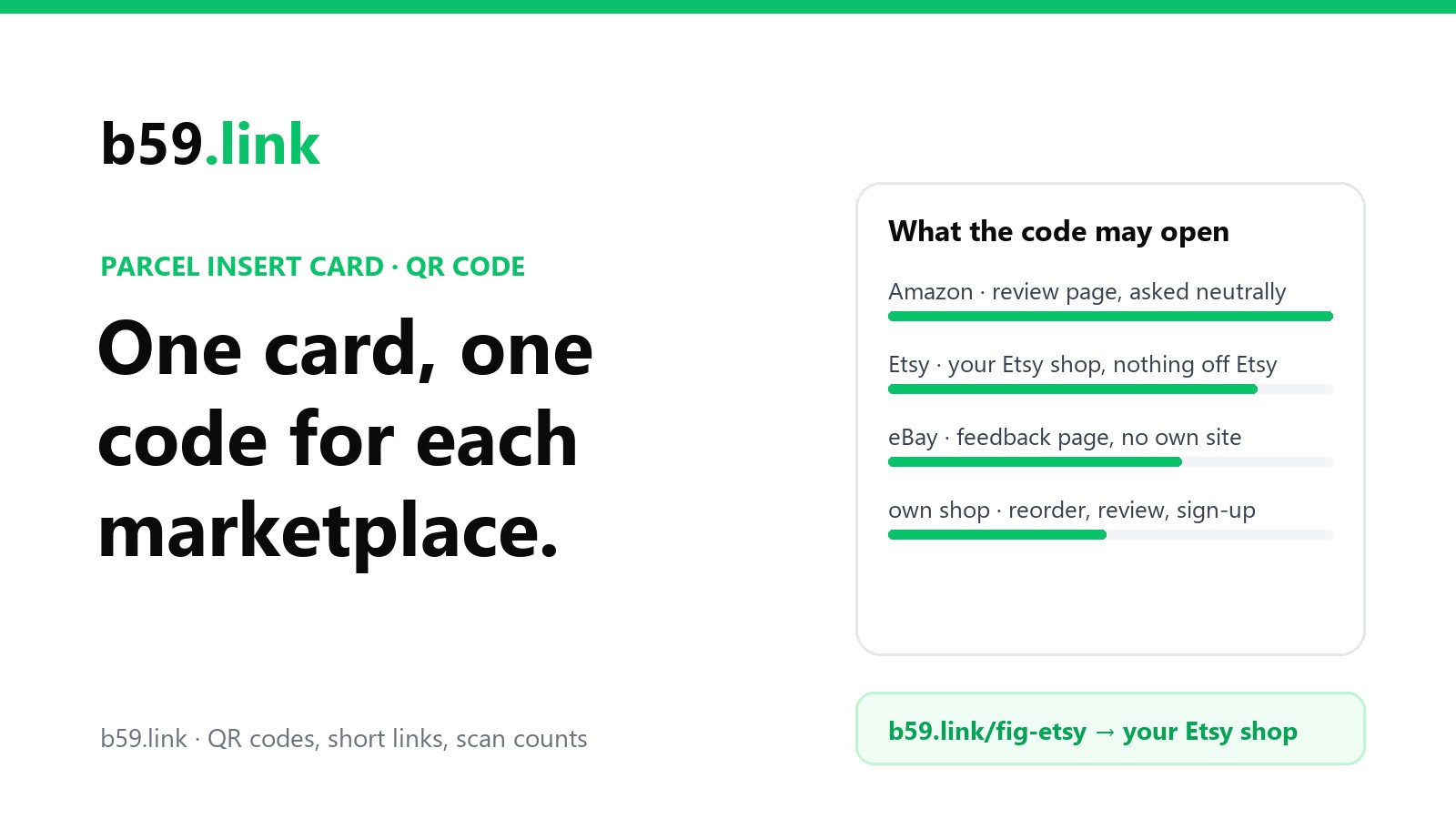
The card in the parcel is the one piece of marketing a small seller is sure the buyer will touch. It falls out when the box is opened, it gets read while the product is still in the other hand, and it is the only moment the seller gets to say thank you in their own voice. So most cards carry a QR code, and most of those codes ask for one of two things: a review, or the next order.
Both are where the marketplaces draw hard lines. A card that's fine in a parcel from your own shop can get an Amazon or Etsy account suspended if it goes out in that marketplace's orders. This guide sets out what Amazon, Etsy and eBay say in their own policy pages (read on 30 October 2026), what the code should open for each of them, how to count scans per 100 orders so you know whether the card does anything, and how the print run changes if the destination ever has to change.
What each marketplace's own rules say
Named means the policy says it in so many words; risky means it falls under a broader rule (Etsy's ban on inflating a review score, eBay's on manipulating feedback) that the platform decides case by case. A card is printed in hundreds, so treat risky as no.
Amazon
Amazon's Selling policies and seller code of conduct lets sellers ask their own customers for reviews in a neutral manner, and then lists what is not allowed: paying for or offering an incentive (coupons, free products) for writing or removing a review, asking for positive reviews only, asking only customers who had a good experience, and asking someone to change or remove a review. The same page bans diverting Amazon customers to another website and says marketing communications are prohibited.
Inserts themselves are allowed. An Amazon staff reply in the Seller Forums on product inserts and QR codes says inserts are commonly used to thank customers, social media handles may be printed on them, and gives three examples of acceptable QR code destinations: the Amazon review submission page, a warranty page and a product support page. The same reply says the code must not take conversations off Amazon or help manipulate reviews. An earlier Amazon policy reminder (November 2019) singles out the most common card of all: asking happy buyers for a review and unhappy ones to contact you instead is prohibited.
Etsy
Etsy rewrote its Off-Platform Transactions Policy on 5 October 2026 and it is now blunt. It lists four things Etsy doesn't allow: telling a buyer to pay or buy outside Etsy checkout (including on a personal website, social media shop or another marketplace), sharing contact details to complete a sale off Etsy, offering off-platform discounts, free items or cheaper postage, and using a QR code to direct members off Etsy. That last one has no exception in the text, so a code on an Etsy insert card should open a page on Etsy.
Etsy's Seller Policy adds two more lines that matter for a card: reviews and responses may not include shilling or otherwise falsely inflate a shop's review score, and a buyer's details may only be used for Etsy-related communication; you may not add a buyer to your email or physical mailing list without their consent.
eBay
eBay's Offering to buy or sell outside of eBay policy bans referring to or promoting external websites that facilitate sales outside eBay, using contact details from an eBay sale to offer items off eBay, and offering catalogues for ordering direct. Its Feedback manipulation policy (updated 10 October 2025) makes clear that any incentive for positive feedback is not allowed, and the Feedback extortion policy bans offering refunds or extra items in exchange for specific feedback or for revising a negative one.
Your own shop, and the law under all of them
Orders from your own site have no marketplace rules, but in the US the FTC's rule on consumer reviews (16 CFR Part 465, in force since 21 October 2024) applies to every seller, marketplace or not. Section 465.4 makes it a violation to offer compensation or incentives for reviews conditioned, openly or by implication, on the review being positive or negative. A knowing violation can cost up to $53,088 per violation (the FTC's inflation-adjusted figure from January 2025). A discount for any review, good or bad, is not covered by that section, but it is still banned on all three marketplaces, and Google doesn't allow it for Google reviews either. If your card asks for a Google review, our Google review QR code guide has the exact link and Google's rules.
Why they care: the fee on the next order
The rules are strict because a repeat buyer who moves off the marketplace takes the marketplace's fee with them. Here is what a $40 repeat order (shipping included) costs the seller in selling fees on each channel, at the standard rates for most categories in 2026:
That gap of $2.59 to $4.54 per order is exactly what a 'reorder from our website, 10% off' card is after, and exactly what each marketplace's policy is written to stop. On marketplace orders, the card's job is a review and a better experience with the product; the reorder has to stay on the same marketplace.
Etsy has one sanctioned way to get some of the fee back. With Share & Save turned on, Etsy refunds 4% of an order placed within 30 days of a buyer clicking your trackable shop link (yourshopname.etsy.com); from 20 October 2026 to 4 January 2027 it refunds 6.5%. The link is an Etsy page, so it stays inside the off-platform rule. On a $40 order that is $1.60 back, or $2.60 during the holiday offer. Etsy's help page lists social posts, bios and email newsletters as places for the link; it doesn't mention printed cards either way, and last-click tracking means an Etsy Offsite Ad clicked later takes the credit instead.
What the code should open, channel by channel
We opened both review links without signing in on 30 October 2026. Amazon's create-review?asin= link answers with a redirect to Amazon sign-in that carries the review page as the place to return to; eBay's fdbk/leave_feedback does the same with eBay sign-in. Buyers who are signed in on their phone, which is most buyers, go straight to the review form; the rest sign in once and land on it. The eBay page lists every purchase still waiting for feedback, so one code works for every product you sell there.
The words on the card matter as much as the link. Neutral means the request reads the same whether the buyer loved the product or not:
One link per channel, and counting scans per 100 orders
Because each marketplace needs its own destination, each channel gets its own card, or at least its own code, and the code should hold a short link rather than the marketplace address. Three reasons: you can change where it points without reprinting (when the product gets a new ASIN, or you move the eBay link from a store page to the feedback page); the short link counts every scan; and a short address makes a smaller code (see the size table below).
Then divide scans by orders shipped with that card. Scans per 100 orders is the number that compares channels and card versions fairly, because a busy channel will always get more scans in total. The figures below are made up to show the reading, not from a real shop: a small candle maker shipping 240 orders in October.
Read it next to what each platform reports for the same weeks: new reviews on Amazon and eBay, Share & Save orders on Etsy, orders with the THANKS10 code on your own shop. If scans are healthy and reviews don't move, the page behind the code is the problem (a sign-in wall, the wrong product). If scans are near zero, the card itself is: people aren't noticing the code or don't see why they would scan it.
Testing two versions of the card
A short link per batch lets you test the card's wording. Print half the Etsy run with 'Care guide and reorder' over the code and half with 'Thank you from the workshop', each with its own link (fig-etsy-a, fig-etsy-b), and pack them alternately so each version goes in the same number of orders.
Be patient with the counts. Say after three months each version went in 90 orders and version A got 16 scans to B's 8, which reads as 17.8 against 8.9 per 100 orders. With only 24 scans in total, a split at least that lopsided happens by pure chance about 15% of the time, even if both cards are equally good. At twice the numbers (32 against 16) that drops to about 3%. Keep both versions going until you have around 50 scans between them before you reprint the 'winner'. Our article on one short link per channel covers what click counts can and can't tell you, including phones that open a link twice.
How big the code on the card should be
A card is read in the hand, 15 to 30 cm from the phone, so the code can be much smaller than on a poster. We encoded six typical destinations at error correction level M and worked out the space each needs (code plus its 4-square blank margin) for a phone to see 3 camera pixels per square at each distance. The camera model is the one from our QR printing guide and slide articles: a 1920-pixel frame across a 67° field of view, about 1,445 pixels per metre at 1 metre.
So on a postcard-size or business-card-size insert, 20 to 25 mm holding a short link scans comfortably from arm's length, and leaves room for the words that make people want to scan. Go bigger only if you have the space; never print the long UTM-tagged address straight into the code. Use matte card if you can: gloss stock under a kitchen light puts a white streak across the code. Put the short address in text under the code too, for buyers who would rather type it.
Print run against a destination that changes
Insert cards get cheap per card only in big runs, and a big run lasts months. Prices for 4 x 6 inch, full colour both sides, 16 pt card from one US online printer (Acme Prints), read 30 October 2026, plus NextDayFlyers' price for a short run:
Two worked cases for the candle maker above:
A printed address that changes. One shared design, 2,500 cards, with a discount URL printed straight into the code. The offer ends after three months, when 720 cards are used. The other 1,780 cards are worth $168 at 9.5¢ each and now point at a dead offer, so they go in the bin and a new run is ordered. With a short link in the code, the destination changes in a minute and the cards keep going out.
A card per channel. Because Amazon, Etsy and eBay each need their own destination, the shop prints four versions for eight months instead of one: Amazon 960 cards (a 1,000 run, $142.31), Etsy 480 (500, $112.44), eBay 240 (250, $85.56) and own shop 240 (250, $85.56). That's $425.87 against $236.63 for a single 2,500 run: $189.24 more, or about 10¢ per order over the 1,920 orders. Many printers price several versions in one order lower than separate orders, so ask for a 'multiple versions' quote before ordering four separate runs.
If 10¢ an order is too much, keep one shared card with no channel-specific words, and print the code only on the versions that need it: the own-shop card, where a reorder link is allowed and pays for itself, and the Amazon card, where the review page is the one thing worth scanning.
Checklist before you order the cards
1. One card or one code per channel: Amazon, Etsy, eBay and own shop each open a page their rules allow.
2. Marketplace codes open the marketplace: review page, feedback page, your store, your Etsy Share & Save link.
3. Review requests read the same to a happy and an unhappy buyer; no 'contact us first'.
4. No discount, gift or entry into a draw for a review, on any channel.
5. No website, newsletter or 'order direct' on marketplace cards, in the text as well as in the code.
6. A short link in each code, with its short address printed underneath: 20-25 mm on the card.
7. A separate short link per card version or batch, and scans divided by orders shipped with it.
8. Wait for about 50 scans before calling one version the winner.
9. Size the print run to how long the words will stay true; the destination can change, the text can't.
Make one short link and QR code per marketplace, change where each points without reprinting, and see scans per card. Free.
Make a QR codeTesting card versions or batches? Make a set of named short links in one go.
Open campaign linksMore on codes printed on things that leave your hands: QR codes on packaging: what to encode so it outlives the box.
Sources
- Amazon: 'Selling policies and seller code of conduct' (Seller Central help G1801, US), read 30 October 2026: neutral review requests, incentives, positive-only and selective requests, circumventing the sales process, marketing communications.
- Amazon Seller Forums: staff reply 'Product Inserts meets QR codes - What you need to know' (inserts allowed, social handles, review page / warranty / support page as acceptable QR destinations); 'Policy Reminder: Product Packaging and Inserts' (November 2019, as dated by Web Retailer, updated 23 February 2024).
- Etsy: 'Off-Platform Transactions Policy', last updated 5 October 2026; 'Seller Policy' sections on reviews and on privacy and buyer information, read 30 October 2026; Help Center 'How to Save on Etsy Fees with the Share & Save Program' (4% refund, 30 days, 6.5% from 20 October to 4 January, yourshopname.etsy.com links, last-click rule).
- eBay: 'Offering to buy or sell outside of eBay' policy; 'Feedback manipulation policy' (updated 10 October 2025); 'Feedback extortion policy'; selling fees help page ($0.30 / $0.40 per-order fee).
- FTC: Trade Regulation Rule on the Use of Consumer Reviews and Testimonials, 16 CFR 465.4 (effective 21 October 2024); civil penalty adjustment to $53,088, Federal Register, 17 January 2025.
- Fees: Amazon 15% referral fee for most categories, eBay 13.6% final value fee for most categories, Etsy 6.5% transaction fee, 3% + $0.25 US payment processing and $0.20 listing fee, as published for 2026.
- Review link test: amazon.com/review/create-review?asin= and ebay.com/fdbk/leave_feedback opened without a session on 30 October 2026 (both 302 to sign-in with the review page as the return address).
- QR sizes: our own encoding with segno 1.6.6 at level M, 4-square margin, 3 camera pixels per square at 1,445 px per metre at 1 m.
- Print prices: Acme Prints 4 x 6 postcards (16 pt, both sides), NextDayFlyers 4 x 6 postcards (100, 14 pt), read 30 October 2026.
- Chance figures: two-sided binomial test, 16 of 24 (15.2%) and 32 of 48 (2.9%) scans going to one of two equal card versions.