An instruction leaflet has a strange life. It's printed in a batch of five or ten thousand, folded into boxes over the following months, sits in a warehouse and on a shop shelf, and then gets opened on a kitchen table by someone who wants the blender working before dinner. Most leaflets are read once. The code on it gets scanned on that first evening, and again two years later when the lid stops clicking shut and the owner wants to know whether a new seal is something they can buy.
So the link in a leaflet has to keep working for the life of the product, long after the print run is gone, and nobody can reprint the leaflets that are already sealed in boxes. This guide is for small makers: how long that really is, what typically breaks, how many links you actually need across products and languages, what warranty registration numbers look like (and what US law says you can't make depend on it), what the EU allows you to move online from 2027, and what you can count.
How long the link has to work
Count from the last box sold, not the first leaflet printed. Fill in your own numbers; the example is a small kitchen appliance.
Twelve years is longer than most web addresses last. Pew Research Center sampled pages from each year between 2013 and 2023 and found that 38% of the pages that existed in 2013 could no longer be reached in late 2023. For machinery sold in the EU there's now a legal floor too: digital instructions have to stay online for the machine's expected lifetime and for at least 10 years after it's placed on the market (more on that rule below).
What breaks, and it's rarely the code
The printed squares last as long as the paper. What goes is the thing behind them. The usual suspects, with real cases:
- The video host changes its rules. On 23 July 2021 YouTube made every unlisted video uploaded before 1 January 2017 private, unless the channel owner had opted out in time. Unlisted is exactly how many makers host setup videos they don't want in their public channel. Every printed code that pointed straight at one of those videos, and every embed, stopped playing that day.
- The shop moves platform. /products/k200-blender becomes /shop/p/1183, and the spare-parts page you printed is now a 404. The seal is still for sale; nobody can find it.
- The domain changes. Even the companies that sell registration software move: the case-study pages at brij.it now answer with a 301 to brij.ai (checked 28 October 2026). Their old links still work because someone set up the redirect. Plenty of rebrands don't.
- The page is replaced by a newer model's page. The K200 is discontinued, its page is redirected to the K300, and the K200 owner scanning for the manual lands on a sales page for a product they don't own.
The fix is the same in every case: the leaflet holds an address you control that does nothing but forward, and the forwarding is something you can change in a minute. Then the video can move to another host, the shop can move platform and the product can be discontinued, and you update one destination instead of wishing you could recall 5,000 leaflets. Our packaging article goes through the options (a generator's address, a page address, an address on your own domain that forwards), and the same reasoning applies to the leaflet inside the box.
Why not just reprint?
The leaflet itself is cheap. A UK trade printer lists 5,000 double-sided A4 leaflets on 130 gsm gloss, folded, at £187.59 before VAT (about 3.8p each) and 10,000 at £325.39 (about 3.3p), checked 28 October 2026. The problem is the stock that already has the old leaflet sealed inside. If 1,800 boxes of a 5,000 run are packed, in transit or on shelves when the link breaks, those 1,800 owners get the dead link whatever you print next, and opening and repacking boxes costs far more than the paper.
One link per product and leaflet edition, not one per button
The tempting design is a code for each thing: setup video, full manual, spare parts, register your warranty. Four codes on a leaflet are four addresses to keep alive and four things to print big enough, and people scan the first one they see. One code per leaflet, opening a short page for that product with those four buttons on it, works better, and the page can change as the product ages: setup video first in year one, spare parts first in year four.
Languages decide how many leaflets, and so how many links, you have. A maker with six products shows how fast it grows:
Twelve to 72 links is a list one person can keep in a spreadsheet. Two hundred and eighty-eight is a list nobody checks. Two choices keep it small:
1. A multilingual leaflet gets one code, and the page picks the language. Detect the browser's language and show a language switch at the top. People in Belgium or Switzerland read more than one, so never hide the switch.
2. A single-language leaflet gets its own code, because then the page can open in the right language without guessing, and the scans tell you which market the leaflet is being used in.
A naming pattern that stays readable for years: product, then market or language, then print run if you want it. b59.link/k200-eu, b59.link/k200-us, b59.link/k200-de-r3. Print the short address in words beside the code (b59.link/k200-eu), so the owner of a leaflet that's been in a drawer with a leaking battery can still type it.
The print-run suffix is worth it if you change the leaflet between runs: when a scan arrives from -r1 in 2029 you know that owner has the old safety wording, or the old part numbers, and the page can say so.
Warranty registration: what the numbers look like
Registration is the button makers care most about, because it's the only way most of them ever learn who bought the product. The honest figures are low. The US Consumer Product Safety Commission asked firms about 21 recalls of cribs, strollers, high chairs and similar products between September 2010 and May 2015, products where a registration card in the box is required by law. In the 18 recalls where cards had been included, an average of 13% of buyers had registered, with a range from 1% to 45% (CPSC report to Congress, February 2016).
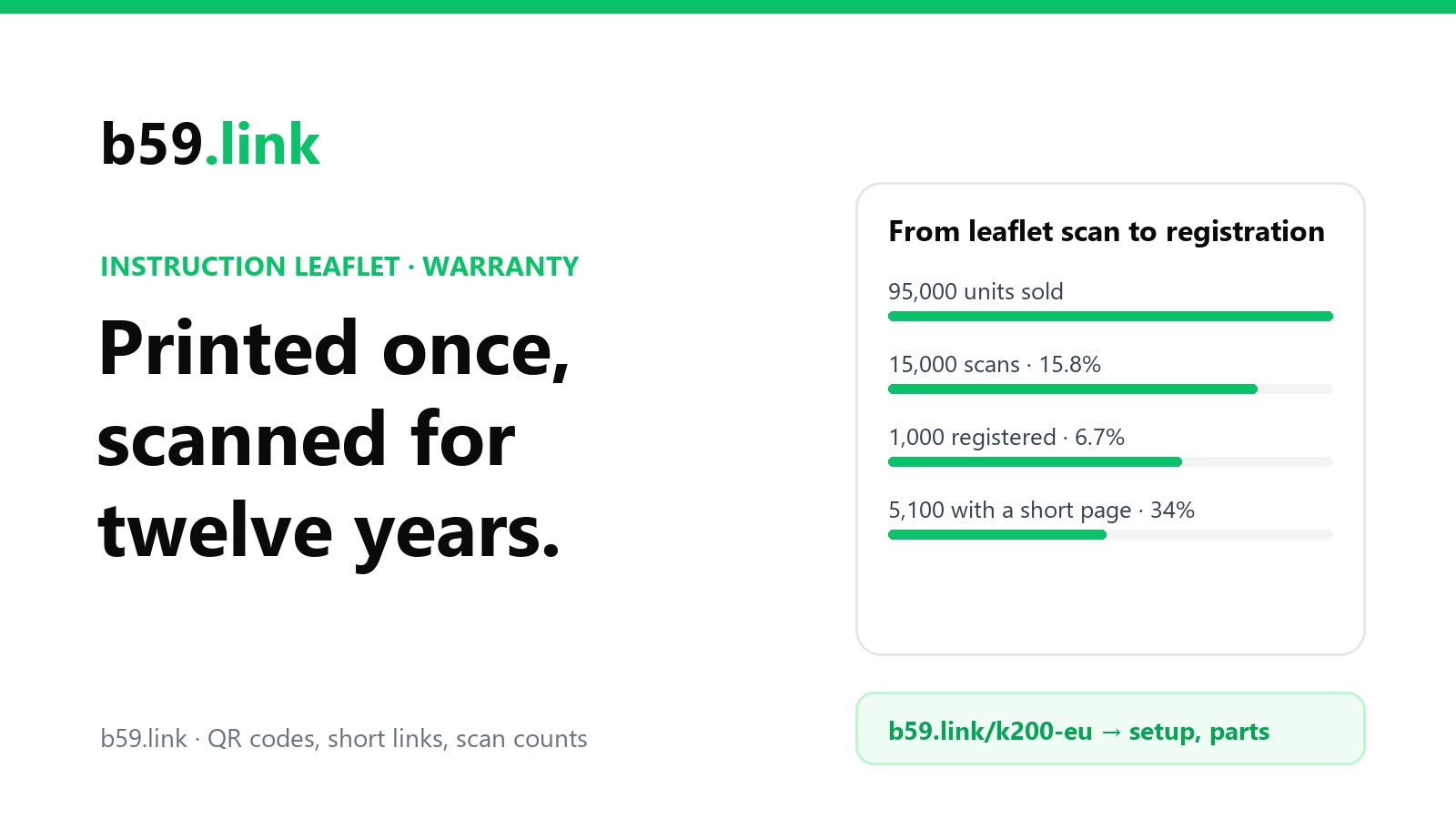
Moving registration from a card to a code helps only if the page after the scan is short. One published before-and-after, from a registration vendor's own case study (so read it as the vendor's numbers): Homedics sold about 95,000 of one diffuser through Costco; its quick-start guide's code was scanned about 15,000 times but produced only about 1,000 registrations. After a shorter mobile registration page, the share of scans that ended in a registration rose to 34%. Worked through:
Two things stand out. About one buyer in six scanned the code at all, so the code is a better route than a card for the people who use it, but it doesn't reach the other five. And the form, not the code, was the leak: the same 15,000 scans gave five times as many registrations once the page asked for less.
For a small maker selling 3,000 units a year, the same rates mean roughly 470 scans, and somewhere between 30 registrations (with a long form) and 160 (with a short one). That's the scale to plan for: enough to email a safety notice to, not a marketing list.
What people say stops them
The same CPSC report surveyed 522 consumers about registering. 59% named unwanted communication as a concern, 79% said they'd be more likely to register if companies were barred from contacting them about anything other than safety, and 78% preferred registration to happen automatically. The page after the scan should answer that worry in its first line, in plain words: what you'll send and what you won't.
What US law says you can't do
Under the Magnuson-Moss Warranty Act, the FTC's rule (16 CFR 700.7) says a full warranty can't be made to depend on returning a registration card. You can suggest registering as a way to record the purchase date, but you have to say that not registering doesn't affect the owner's rights if they can show the date another way. The FTC's guide for businesses adds that a limited warranty may require registration only if the warranty says so clearly. In practice: write "Register to get recall and safety notices and to make claims quicker", not "Register to activate your warranty", unless your lawyer has checked a limited warranty that says so.
If you make durable infant or toddler products sold in the US (cribs, high chairs, strollers, carriers and the other categories in 16 CFR 1130), the postage-paid registration card is required whatever the leaflet says; a code is an addition to it, and the information can be used only for safety notices.
What the EU lets you move online, and what stays on paper
Two EU regulations matter for a small maker, and they pull in different directions.
Machinery (Regulation 2023/1230), from 20 January 2027. It replaces the Machinery Directive and covers more consumer products than people expect: power tools, garden machinery and other powered machinery sold to households. Instructions may be supplied in digital form instead of on paper, if the manufacturer:
- marks on the product (or, if that's not possible, the packaging or an accompanying document) how to reach the digital instructions, which is the code and the printed address;
- offers them in a form the user can print, download and save on a device, so they're available during a breakdown;
- keeps them online for the product's expected lifetime and at least 10 years after it's placed on the market;
- sends a free paper copy within one month if the buyer asks at the time of purchase.
And one condition that matters most to consumer makers: where the machine is meant for non-professional users, or could foreseeably be used by them, the safety information needed to put it into service and use it safely must still be on paper. So the leaflet doesn't disappear. It shrinks to the safety information, the contact details and the code, and the full manual moves behind the link, in a language the user understands as decided by each member state.
For that 10-year rule a short link helps with the moving parts, but the thing at the other end must be a downloadable PDF of that exact model's instructions, not only a video or a help-centre article that gets rewritten. Keep the PDF for every model and every revision, named by model, and keep it after the model is discontinued.
Everything else (General Product Safety Regulation 2023/988, since 13 December 2024). For consumer products outside the specific rules, the manufacturer must make sure the product is accompanied by clear instructions and safety information in a language consumers in that country can easily understand, and must put its name and its postal and electronic address on the product, or where that isn't possible on the packaging or an accompanying document. The regulation doesn't offer the machinery-style digital route, so treat a code here as an extra: the instructions and warnings the product needs still come in the box.
This is a summary to help you ask the right questions, not legal advice; your product's own rules (toys, electrical equipment, radio equipment and others) may add more.
What a small maker can count
With one short link per product and leaflet edition, every scan is counted against that leaflet without collecting anything about the person. Over a year, the counts answer questions that are otherwise guesses:
The last row is the one people miss. A link that silently breaks looks exactly like a product nobody needs help with. Scan your own leaflets now and then, from the actual printed sheet, and check every link on your list still opens the right page; our link list checker follows up to 25 addresses at once and shows which are dead.
Two honest notes about using a short-link service, ours included. First, the scans you count are scans, not people: the same owner scanning twice is two. Second, for an address that has to last 12 years, a forwarding address on your own domain (go.yourbrand.com/k200-eu) is the safest choice, because then no other company's decisions can break it. A short link on a service like b59.link is quicker to set up, counts scans out of the box and suits shorter-lived leaflets, inserts and promotions; if you use one for a long-lived product, export your list of links and destinations and read what happened when goo.gl and git.io shut down first.
Checklist before the leaflet goes to print
1. One code per leaflet edition (product + market or language), opening a product page with setup, manual, parts and registration.
2. An address you control that forwards, never a direct video link or a shop URL; the short address printed in words beside it.
3. The page has a downloadable PDF of that exact model's instructions, kept for the product's life and 10 years.
4. Safety information stays on paper in the box, in the market's language.
5. Registration asks for an email and a purchase month, says in its first line that you'll only send safety and recall notices unless they tick a separate box, and never claims the warranty depends on it.
6. A plan for discontinuation: the page stays, with the manual and parts, and doesn't redirect to the new model.
7. Decode the final artwork file and check the address inside it before approving the proof. Our QR checker reads it in your browser.
8. Write down who renews the domain and who owns the list of links. In 2035 that note is the leaflet's real spare part.
Make one short link and QR code per leaflet, change where it points when the video or shop moves, and count scans per product and language. Free.
Make a QR codeSources
- Regulation (EU) 2023/1230 on machinery, Article 10(7) (digital instructions: how to access, print and download, lifetime and at least 10 years, paper copy free within one month on request at purchase, paper safety information for non-professional users, language), EUR-Lex; application from 20 January 2027 after the corrigendum of 4 July 2023 (OJ L 169).
- Regulation (EU) 2023/988 on general product safety, Article 9(6) and 9(7) (contact details on the product; instructions and safety information in a language easily understood by consumers), EUR-Lex; applies from 13 December 2024.
- US CPSC, Report to Congress pursuant to Section 104(d) of the CPSIA, Recall Notification Effectiveness, February 2016 (21 recalls, September 2010 to May 2015; 13% average registration, 1-45%; survey of 522 consumers).
- 16 CFR 700.7 (FTC, use of warranty registration cards under the Magnuson-Moss Warranty Act); FTC, Businessperson's Guide to Federal Warranty Law; 16 CFR 1130 (CPSC, durable infant or toddler product registration cards).
- Brij, Homedics case study (95,000 units, about 15,000 scans and 1,000 registrations before; 34% scan-to-registration after), brij.ai, read 28 October 2026. Vendor-reported figures; our calculation of the shares.
- YouTube Official Blog, 'Update to YouTube unlisted links' (unlisted videos uploaded before 1 January 2017 set to private from 23 July 2021), and YouTube Help, 'Older unlisted content'.
- Pew Research Center, 'When Online Content Disappears', 17 May 2024 (38% of 2013 pages unreachable in 2023).
- Tradeprint, instruction manual / leaflet printing, A4 130 gsm gloss, folded, prices before VAT, read 28 October 2026.