Once a month somebody walks round the building, looks at each fire extinguisher and first-aid kit, and ticks a sheet. The sheet lives in a folder in the office, or on a clipboard that is somewhere else when you need it. Every few months a check is missing and nobody can say when the extinguisher in the basement was last looked at. A QR code at each station can fix that part. It can't fix the tag, and this article says which is which.
What follows: what the rules actually require (OSHA, NFPA 10, BS 5306-3), what has to stay on the physical tag, a size test for codes on small station labels, our own test of how much damage a code takes, and how to set up one link per station so a missed check shows up.
What the rules say, in one table
Three things to take from it. The monthly check is a look, not a service: in place, undamaged, reachable, pressure gauge in the green, seal intact. The annual service is done by someone competent and recorded on the extinguisher itself. And NFPA 10 lets the monthly record be electronic, as long as it shows date and initials and covers at least the last twelve checks. Check which edition your fire code adopted and ask your inspector; local rules and your insurer can ask for more.
What stays on the physical tag, no matter what
- The service tag or label from the company that did the annual work. It is how an inspector sees from two metres away that this unit was serviced this year. A QR code does not replace it.
- The seal and the gauge. They are the check. A code that says 'checked' for a unit with a broken seal is worse than no code.
- The station number, printed in words next to the code. If the phone, the network or the short link is down, the number still lets a person find the right page or write on the paper sheet.
- A backup way to log it: a paper sheet or the tag's own initials box. Inspectors ask to see records; a phone with no signal in a plant room won't show them.
In our reading of the sources, NFPA 10 lists the tag, a checklist on file and an electronic system as three equal places for the monthly record, so a scan log is allowed where your authority accepts it. Ask before you drop the paper, and keep the old sheets until they say yes.
One link per station, not one link for the form
The useful trick is that every station gets its own short link, for example b59.link/ext-0412, that points at the same check form with the station already filled in. Then a click on the link counts as a check attempt, and the click stats per link tell you which stations were scanned this month and which weren't. The form is where the actual answers go (in place, seal intact, gauge green, clear access, damage: yes or no), and the answers sit in a sheet you can export for the inspector.
Because the link is yours, you can also change where it points: a new form next year, a new check sheet after a rename, a replacement extinguisher with the same station number. The printed code never changes. That is the whole reason not to print the form's own address on the label.
How small can the label be? Our size test
Station labels are small: a sticker on the extinguisher body or a strip on the first-aid box lid. We encoded four typical payloads with the segno encoder and worked out the size of one square in a 19, 25 and 38 mm space (including a 4-square white margin), then the distance a phone can read it from, with the same camera maths as our equipment label article: 1.445 pixels per millimetre at 1 m, 3 pixels per square for a worn label.
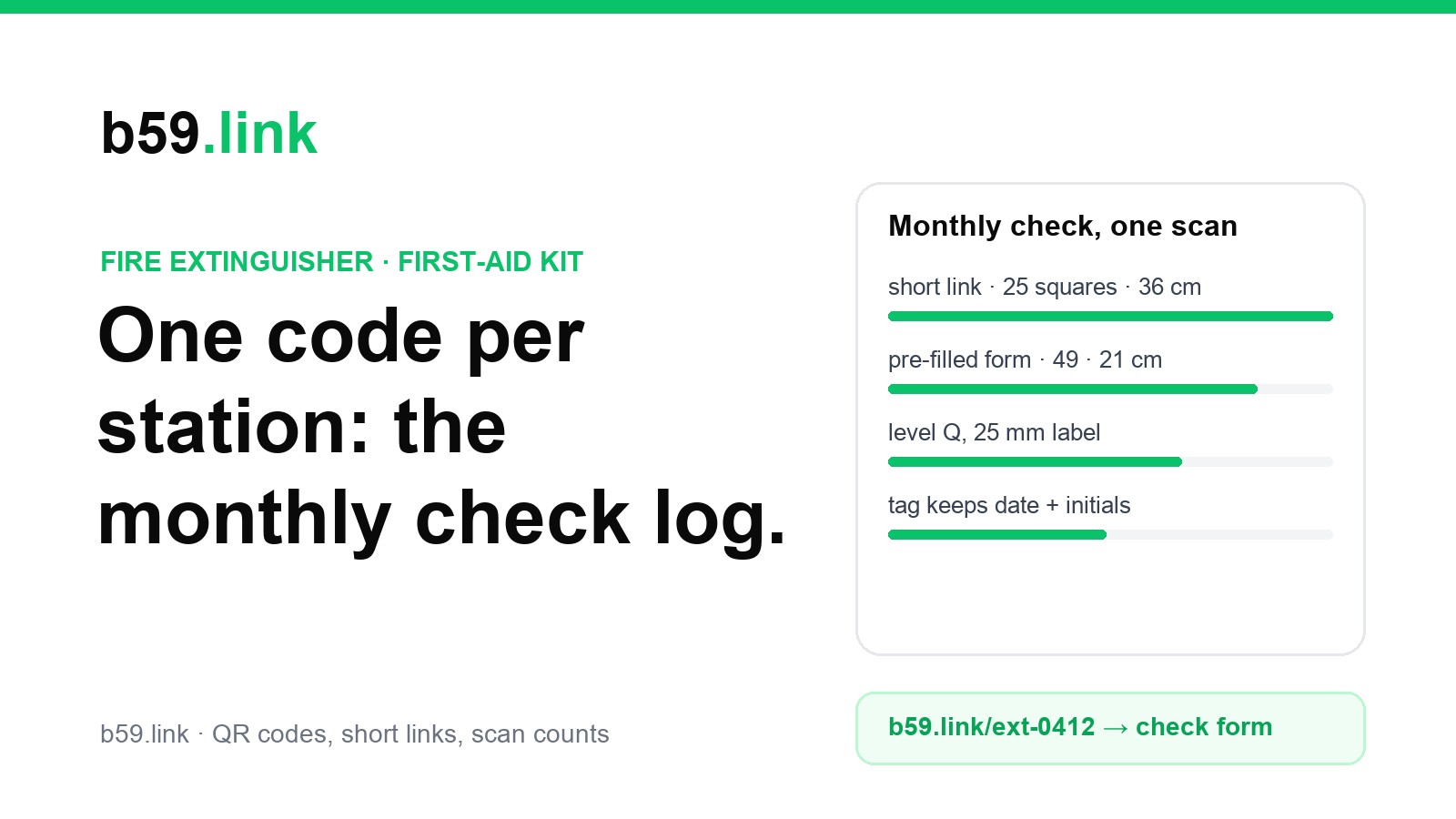
Practical result: a short link on a 25 mm label reads from about 33-36 cm; the long pre-filled form link needs the phone 21-25 cm away, which is awkward on a wall-mounted extinguisher behind a bracket. That is the second reason for the short link.
How much damage can the code take? Our scratch test
Extinguisher labels get wiped, knocked and scraped. We generated each code at each error correction level, covered random rectangles in white, black or grey over 5, 10, 15, 20 and 30 % of the code area (100 random layouts each; patches were allowed to hit the corner squares), and counted how many a standard decoder (zxing-cpp) still read. It is rough on purpose: real scuffs are usually kinder than this.
Two things stand out. At 5 % damage even level Q fails 28 times in 100 on the short link, because a small code is mostly corner squares and one hit costs a lot. And nothing survives 30 %. Level H on the short link reads 47 of 100 with a tenth destroyed, but costs a bigger code (33 squares instead of 29), so on a 25 mm label each square shrinks from 0.68 to 0.61 mm. Our pick: level Q for the short link, and replace the label when it is visibly scuffed rather than trusting error correction.
Offline basements and plant rooms
The classic missed check is the extinguisher in a plant room with no signal. Options, roughly best first:
- Wi-Fi or a signal booster in that room: cheapest fix if the problem is one room.
- Walk the round on paper with the station numbers, type it in at the desk. Dull, and it works.
- Scan on the landing, look at the station: the scan happens where there is signal. Fine for logging, but then the scan proves less.
- Scan first on the way in, so the page is already open when the signal drops, and tick the form at the station.
Be honest about what a scan proves. It proves someone had a phone near the code. It does not prove they looked at the gauge. Pair it with a form that makes them answer the questions.
First-aid kits and restocks
OSHA has not adopted ANSI/ISEA Z308.1-2021 but points employers to it for minimum kit contents. It has Class A and Class B kits (B adds a splint and a tourniquet and larger quantities) and the 2021 edition added a foil blanket. University safety guidance asks for a monthly visual check of every item, dated records, and replacement of anything past its expiry. A QR code on the box lid does the monthly check the same way, plus a second button: 'Something is missing or used', which pre-fills the kit number and goes to whoever restocks. Someone using the last bandage on a Tuesday reports it on Tuesday, not at the next monthly check.
Before you stick it on: the checklist
1. One short link per extinguisher or kit, with the station number in the link (ext-0412).
2. Level Q, 25 mm or larger, on a matte label so glare doesn't break the read.
3. The station number and the short address printed in words next to the code.
4. The service tag and seal left exactly as the servicing company leaves them; never cover them.
5. A form with real yes/no questions, not one 'checked' button; export the answers for the inspector.
6. Ask your inspector or insurer if a scan log is accepted in place of the paper sheet; keep paper until they say yes.
7. Look at the click stats on the 25th and chase the stations with zero scans.
8. Walk past the labels now and then: a stranger's sticker over yours is a real thing, see fake QR code stickers.
Make one short link and QR code per station, point them all at your check form, and see which stations were scanned this month. Free.
Make a QR codeSources
- OSHA, 29 CFR 1910.157(e), portable fire extinguishers: inspection, maintenance and testing (text read on law.cornell.edu/cfr/text/29/1910.157, 21 November 2026): monthly visual inspection, annual maintenance check, record kept one year after the last entry or the life of the shell.
- NFPA 10 monthly record wording (date and initials; tag, checklist or electronic; at least the last 12 monthly inspections) as reproduced in the South Milwaukee fire extinguisher inspection record, which cites [10:7.2.4.3 to 7.2.4.5], and the Minnesota State Fire Marshal hotel extinguisher page. The NFPA 10 text itself was not read; check your adopted edition.
- BS 5306-3 monthly visual inspection and annual service: summaries by BAFE, Human Focus and Fire Risk Assessment Network (UK guidance pages, 21 November 2026). The standard itself was not read.
- ANSI/ISEA Z308.1-2021 first aid kits: ANSI Blog, 'Workplace first aid kits'; University of Texas EHS first aid kit page for monthly checks.
- QR sizes and scratch test: our own, segno encoder and zxing-cpp decoder, 21 November 2026; camera figures as in the equipment label article.