In 2025 shoppers sent back about 15.8% of everything they bought in the US, and 19.3% of what they bought online (NRF with Happy Returns, $849.9 billion in total). If you sell online, roughly one parcel in five or six comes back. The first thing that parcel's customer touches is the paper slip in the box.
Most slips say "to return, email us" or print a long web address nobody types. A QR code fixes the typing. But it is easy to print the wrong thing behind it, because the QR codes carriers use for label-free returns are not something you can print on a slip. Here is what a slip code can and can't do, what Amazon, eBay and Etsy expect, and how to count which channel your returns come from.
The code on your slip is a front door, not a label
You may have seen label-free returns: the customer shows a QR code on their phone at a counter, the clerk scans it and prints the label. That code is made for one return, after the seller approves it. USPS's own description (via its Label Broker service) is that the retailer creates the return shipment first and then sends the customer a QR code or numeric ID. It is "not itself a return authorization", so the seller's policy still decides the deadline and the refund.
So the QR code you print in advance on a slip can only do one thing: open the page where the customer starts a return. That page (or the returns tool behind it) then makes the single-use carrier code. Which carriers do this, according to Loop Returns' help page:
| Carrier / country | Label-free drop-off | What the help page says |
|---|---|---|
| UPS (US) | UPS Store, nearly 5,000 US locations | Customer brings the item and the code; an associate scans it, packs it and prints the label. Opt-in because UPS adds a surcharge. |
| USPS (US) | Eligible post offices | The code works only on the day the return is submitted; otherwise the customer needs a printed label. |
| FedEx (US) | FedEx Office and Walgreens | Customer shows the code at the counter. |
| Canada Post (Canada) | Eligible Canada Post locations | Domestic returns only. |
| Royal Mail (UK) | Eligible Royal Mail locations | Domestic returns only. |
| Evri (UK) | Eligible Evri locations | Listed with several returns tools. |
| Australia Post (Australia) | Post offices | The code is part of the printed label, not shown on its own. |
Source: Loop Returns, printerless returns, read 2026-11-28. Which counters accept a code depends on the label and the location, so tell customers to check before they go.
What each channel expects
If you sell on a marketplace and in your own shop, the same parcel slip goes into boxes from every channel. The rules differ, so one code opening one page is a trap. Read from each platform's own help pages on 2026-11-28:
| Channel | Where the buyer must start | Detail that matters for the slip |
|---|---|---|
| Amazon (seller-fulfilled, US) | In Amazon, from the order | Most items can be returned within 30 days of the estimated delivery date. Amazon approves US returns inside its policy automatically and issues prepaid labels through its shipping programme; sellers answer anything else within 24 hours and talk to the buyer through Buyer Seller Messaging. |
| eBay | My eBay > Purchases > Return this item | Sellers have 3 business days to respond. A return can go ahead even when your listing says no returns, if the item is faulty or not as described. If a label's QR code won't scan, the buyer asks eBay to step in rather than starting over. Money Back Guarantee also excludes purchases paid for outside eBay. |
| Etsy | Contact the seller first, Help with order | Sellers need not accept returns unless their shop policy says so. Agree the details in a message before anything is sent. A buyer can open a case only 48 hours after contacting the seller. |
| Your own shop | Wherever you say | Your rules; this is the one channel where the slip code can open a real return form. |
Sources: Amazon seller-fulfilled returns, eBay returning an item, Etsy returns and exchanges. Policies change and differ by country (these are the US and UK pages); check yours before you print.
What that means for the code:
- Amazon and eBay parcels: the code should open a short page that says "start the return in your Amazon / eBay account" with the steps and a link to the account's order list. Don't build a side process: the platform tracks the return, the refund and the buyer protection, and a return you handle by email sits outside it.
- Etsy parcels: the page tells the buyer to use Help with order first, and gives your shop's return window and address rules in plain words, so the first message they send already has what you need.
- Own-shop parcels: open your returns form. This is where you can show the reason list and issue the label or label-free code.
- None of them: never open a page that asks the buyer to log in before they can read your return rules.
We have not tested links that jump straight into one order on Amazon, eBay or Etsy; they need the buyer signed in and an order number we can't put in a printed code, so link to the account's order list instead.
Short link or long address: what it does to the printed code
A slip is a small piece of paper, often printed on an office laser printer or a thermal label printer. The longer the text in the code, the smaller each square gets. We generated codes for four different texts and measured the grid (squares per side) and the size of one square if the code is printed 25 mm and 20 mm wide:
| What is in the code | Characters | Grid at level L (version) | mm per square at 25 mm / 20 mm | Grid at level Q |
|---|---|---|---|---|
Short link, b59.link/r-etsy | 23 | 25 × 25 (v2) | 1.00 / 0.80 | 29 × 29 (v3) |
| Own returns page address, no tracking | 52 | 29 × 29 (v3) | 0.86 / 0.69 | 37 × 37 (v5) |
| Same address plus source, medium and campaign tags | 119 | 41 × 41 (v6) | 0.61 / 0.49 | 53 × 53 (v9) |
| Long address with order-style parameters | 141 | 45 × 45 (v7) | 0.56 / 0.44 | 57 × 57 (v10) |
Made with the open-source Segno library, 2026-11-28, border excluded. The numbers are the grid sizes; we did not run a scan test on printed slips for this article. For how small a square can get on a given printer and how far phones read, see our printing test.
The short link holds a 25 × 25 grid at either error-correction level and keeps squares at 0.8 mm or more on a 20 mm code. The long one drops to 0.44 mm at 20 mm: that is a code a thermal printer smears. And a short link has a second job: you can change where it points after the slips are printed, for example when your returns page moves.
Counting returns per channel
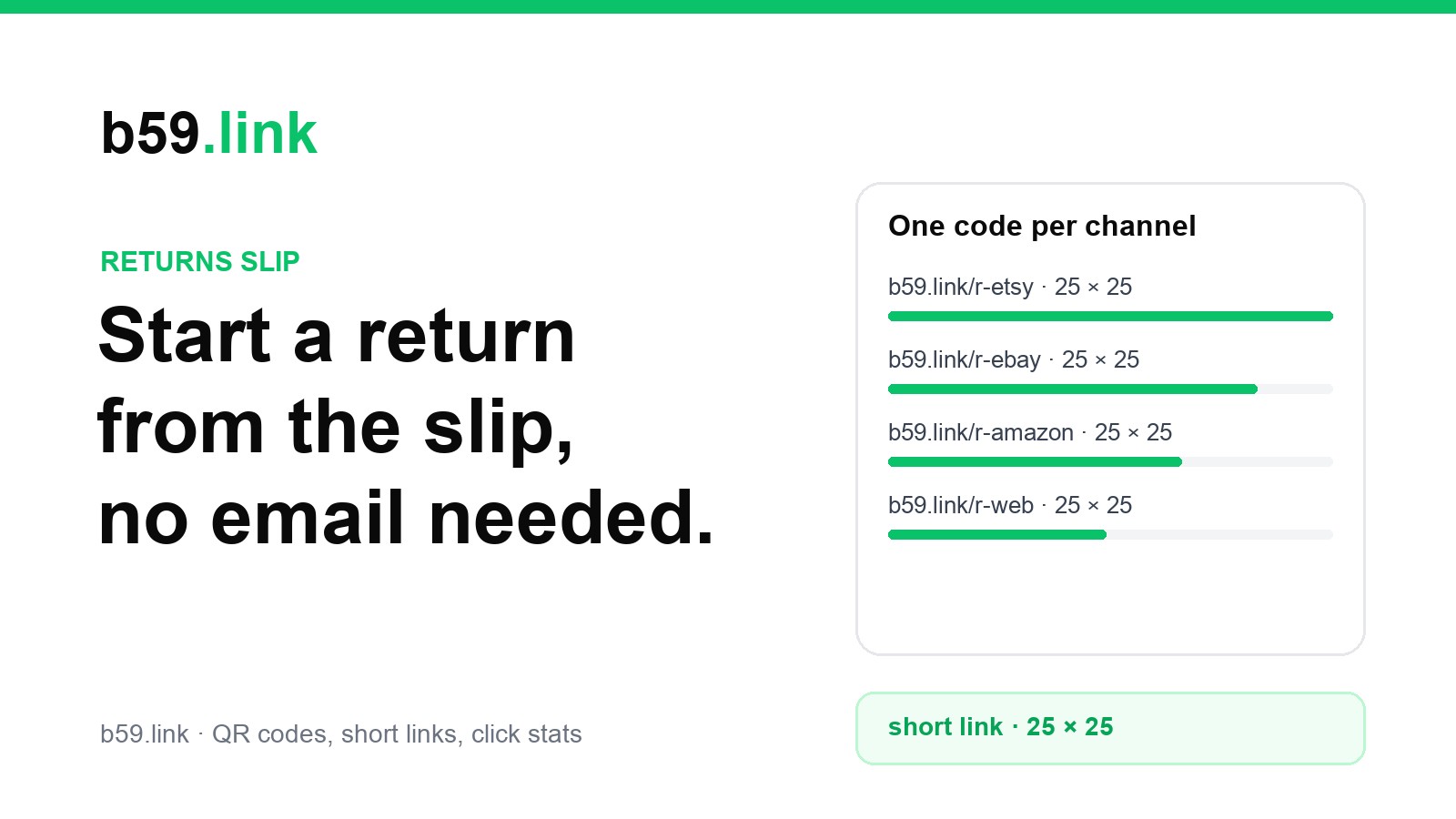
Make one short link per channel and per print run: r-amazon, r-ebay, r-etsy, r-web, and add the run if you reprint (r-etsy-2). Each link's click count is then "people who tried to start a return from that slip". Put the expected volume next to it. With the 19.3% online rate as a rough guide, here is what a month looks like for a seller shipping 400 parcels (made-up channel split, replace with yours):
| Channel | Parcels shipped | Returns at 19.3% | Scans to expect if all go through the slip |
|---|---|---|---|
| Etsy | 180 | about 35 | up to 35 |
| eBay | 90 | about 17 | up to 17 |
| Amazon | 60 | about 12 | up to 12 |
| Own shop | 70 | about 14 | up to 14 |
| Total | 400 | about 77 | up to 77 |
Read the clicks against that. If Etsy shows 8 scans on 35 expected returns, the slip isn't the route most buyers take, and they are going through the Etsy app instead, which is fine for you. If own-shop shows 0 scans on 14 expected returns, the slip is hidden, too small or sits where the packer never puts it. Two cautions on the count: some mail and phone security tools open links before a person does (see why newsletter links get clicked seconds after you send them), and a scan is not a return. The real number of returns is in your order system.
Return reasons are best asked in the form itself on your own page. On marketplace orders you only see them when the platform shows them, so the scan count is the one thing you can add.
Setting up the slip: six steps
- Write down the returns start page for each channel (see the table above). For own shop, build the form first.
- Make one short link per channel at b59.link, named so you can read them later (
r-etsy). - Make the QR code from the short link, not the long address. Keep the white border, at least four squares wide.
- Print the code at least 20 mm wide, 25 mm if you can, in black on white. Not on a coloured or glossy patch.
- Print the same words next to it: "Start a return" and the short link in text, for the person who can't scan.
- Print a test slip, scan it with two different phones, and then check the click shows up on the right link.
Looking at the other side of the same box? See the insert card in the parcel for what marketplaces allow you to say in the box, and one short link per channel for naming links.
You can make the short links and the QR codes for your slip free at b59.link.