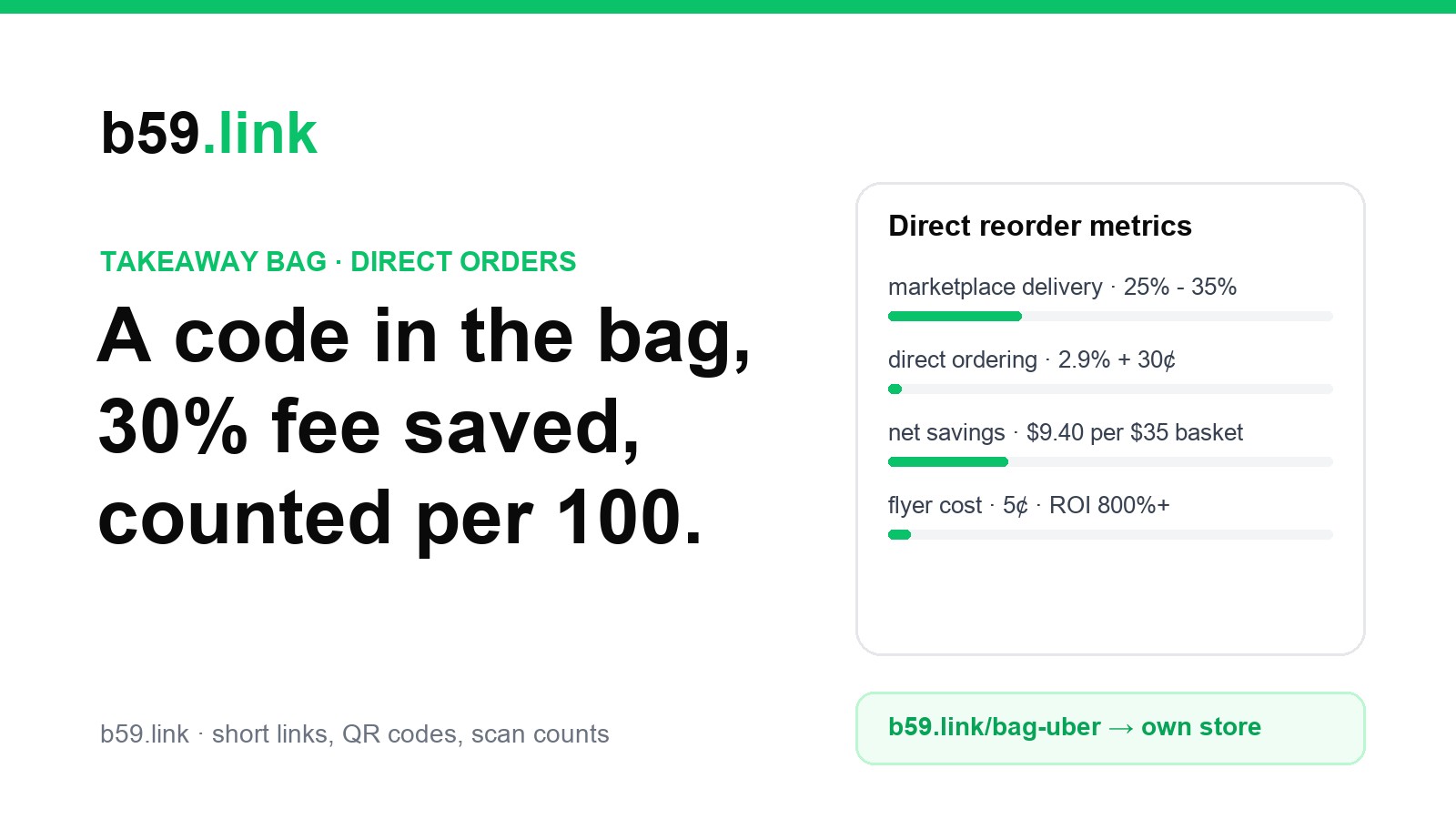
Every time an order leaves your kitchen through Uber Eats, Deliveroo or DoorDash, between 15% and 35% of the ticket stays with the app. On a $35 (£30) dinner, that is roughly $10 going to the delivery platform before you pay for ingredients, packaging, staff or rent.
Slipping a small printed card or bag-seal sticker with a QR code into the delivery bag is the most direct way to introduce that eater to your own website. But many kitchen owners hesitate: will Uber Eats ban your store? Does DoorDash allow discount flyers? How many customers actually scan, and what does the fee math look like when they do?
What Uber Eats, DoorDash and Deliveroo actually allow in the bag
Platform merchant agreements protect their marketplace, but their jurisdiction stops at your food packaging. Here is where the legal and contractual boundaries sit:
| Action inside or on the bag | Allowed? | Platform rules and clauses |
|---|---|---|
| Branded insert card or flyer in bag | Yes (All) | Treated as standard takeaway packaging (like napkins, menus, or loyalty cards) packed by the kitchen. |
| QR code on bag-seal tamper sticker | Yes (All) | Uber Eats explicitly mandates tamper-evident packaging. A printed sticker sealing the bag satisfies safety rules and presents the QR code first. |
| Discount code for direct reorders | Yes (All) | Promoting your own loyalty rewards or first-order vouchers (e.g. DIRECT15) on physical collateral is standard commercial practice. |
| Using app logos on your flyer | No (Breach) | Uber Eats Brand Guidelines, DoorDash and Deliveroo terms strictly prohibit using their wordmarks or logos on unauthorized printed materials. |
| Disparaging app fees in flyer copy | No (Breach) | Text like "Order direct so Uber doesn't take 30%" breaches non-disparagement clauses in merchant terms. Focus on customer value instead. |
| Asking the delivery driver to hand out flyers | No (Breach) | Couriers (Dashers and delivery partners) are contracted solely to transport sealed food packages. They cannot act as independent flyer distributors. |
| Harvesting customer phone numbers from receipts | No (Breach & Illegal) | Order metadata belongs to the platform. Scraping masked phone numbers or physical delivery addresses into marketing databases breaches data privacy terms and GDPR/CCPA. |
The golden rule: keep the insert entirely about your restaurant brand. Treat the delivery bag exactly like a customer walking up to your takeaway counter: your menu, your loyalty perk, your colors, and your link.
The fee gap: what 30% commission really costs your kitchen
Third-party marketplaces don't just charge a transaction fee; their cut comes off top-line revenue before any of your food, labor or overhead costs are deducted. Here is how third-party delivery compares to direct ordering on a standard $35.00 (£30.00) ticket:
| Cost component | Uber Eats / DoorDash / Deliveroo (30%) | Direct ordering (Toast, Square, Shopify) |
|---|---|---|
| Gross customer bill | $35.00 | $35.00 |
| Platform marketplace commission | -$10.50 (30.0%) | $0.00 (0.0%) |
| Payment processing (2.9% + 30¢) | Included in commission | -$1.32 |
| Bag insert flyer cost (amortized) | $0.00 | -$0.05 |
| Net retained revenue to restaurant | $24.50 | $33.63 |
| Net revenue difference per order | +$9.13 (+37.3% more cash retained) | |
In the UK on a £30.00 Deliveroo ticket with 32% commission (£9.60 fee), direct ordering with standard UK card rates (1.75% + 20p = £0.73) and a 4p flyer delivers £29.23 net compared to £20.40 on the app. That is +£8.83 more retained per order.
The 100-bags math: why 3 direct reorders pay for everything
Printing flyers feels like an upfront expense until you calculate the breakeven point. 500 double-sided full-color A6 postcards on thick 300gsm cardstock cost about $25.00 (£20.00), which works out to exactly 5¢ (4p) per flyer. Here is what happens when 100 delivery bags go out the door:
| Conversion scenario per 100 bags | Converted direct reorders | Gross commission saved | Total flyer print cost | Net profit gain | Net ROI |
|---|---|---|---|---|---|
| 1% (Single reorder breakeven) | 1 | $9.13 | $5.00 | +$4.13 | 83% |
| 3% (Conservative conversion) | 3 | $27.39 | $5.00 | +$22.39 | 448% |
| 6% (Realistic with 15% discount) | 6 | $54.78 | $5.00 | +$49.78 | 996% |
| 10% (High-incentive / loyal base) | 10 | $91.30 | $5.00 | +$86.30 | 1,726% |
It takes just <strong>one single reorder per 100 bags</strong> to cover the printing cost of the entire batch. At a modest 6% conversion rate, a kitchen fulfilling 250 delivery orders a week (13,000 bags a year) generates <strong>$6,471.40 in net saved fees</strong> annually, plus 780 repeat direct customer relationships you can reach without paying an ad toll.
Where the QR code should open (and where it should never go)
What happens after the scan determines whether the customer orders or abandons. Three common mistakes sabotage bag campaigns:
- Never link back to your delivery app profile: Linking to your own Uber Eats or DoorDash storefront pays the 30% commission all over again. Point only to your owned online ordering system.
- Never link to a generic website homepage or PDF menu: A hungry customer wants to order food, not read your 'About Us' story or pinch-zoom a 14 MB static PDF. The QR code must open your live mobile ordering catalog directly.
- Pre-apply the introductory discount code: If your card promises "15% off your first direct order with code DIRECT15", append the coupon parameter to your destination link (e.g.
?promo=DIRECT15). When the customer adds items and reaches checkout, the discount is already applied. - Highlight perks app customers never get: Faster kitchen preparation, free house dips, direct loyalty stamps, and menu items exclusive to direct orders.
Counting direct orders: one short link per delivery platform
If you print one generic QR code on every flyer, you will never know which platform delivers your best direct customers. Uber Eats customers might scan at double the rate of DoorDash users, or Deliveroo bags might generate higher average order values.
The solution is simple: create three short links with <a href="https://b59.link">b59.link</a> and print one code per platform pile:
| Bag stream | Short link on flyer QR | Full destination URL with tracking |
|---|---|---|
| Uber Eats orders | b59.link/noodle-uber | https://order.noodles.com/?utm_source=bag&utm_medium=insert&utm_campaign=uber&promo=DIRECT15 |
| DoorDash orders | b59.link/noodle-dash | https://order.noodles.com/?utm_source=bag&utm_medium=insert&utm_campaign=doordash&promo=DIRECT15 |
| Deliveroo orders | b59.link/noodle-roo | https://order.noodles.com/?utm_source=bag&utm_medium=insert&utm_campaign=deliveroo&promo=DIRECT15 |
This setup gives your kitchen three crucial advantages:
- Precise scan metrics per 100 bags: If 100 Uber bags produce 9 scans on
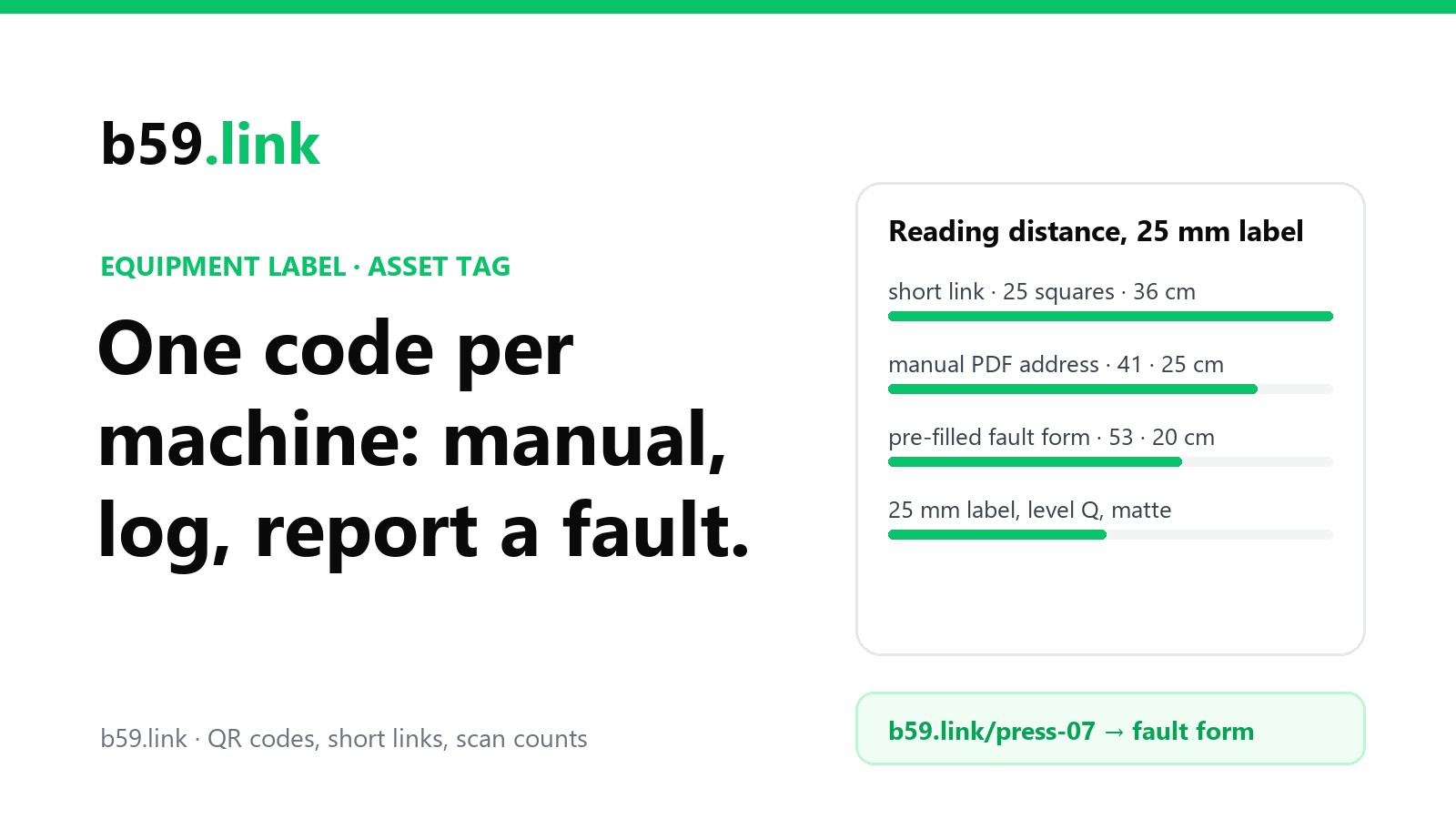
b59.link/noodle-uberwhile 100 DoorDash bags produce 3 scans onb59.link/noodle-dash, you know immediately which audience responds to your offer. - Low matrix density: Encoding a 22-character short link produces a clean QR Version 2 code (25 × 25 modules). A raw 95-character URL with tracking tags produces a dense Version 6 code (41 × 41 modules) with tiny squares that struggle to scan on a crinkled takeaway bag.
- No reprinted card waste: If you switch your online ordering provider from Toast to Square next month, or update your first-time discount code, you simply update the redirect destination in your b59.link dashboard. All 2,000 cards already printed in your storage room continue working without skipping a beat.
Print and sizing specs: cards vs bag-seal stickers
Takeaway food bags get hot, steamy and occasionally crumpled in transit. Flimsy paper flyers will wrinkle before the customer reaches home. Follow these print standards:
| Format | Dimensions | QR code size | Material & print notes |
|---|---|---|---|
| A6 Postcard Insert | 105 × 148 mm (4.1 × 5.8 in) | 25 × 25 mm to 30 × 30 mm | 300gsm or 350gsm silk/matte board. Heavy card stays flat inside steamy bags. Avoid high-gloss laminate that produces harsh reflection under kitchen lighting. |
| Bag-Seal Tamper Sticker | 50 mm round or 50 × 75 mm rectangle | 20 × 20 mm | Semi-gloss or kraft paper sticker. Placed directly across the folded top of brown paper bags. The short link ensures modules stay above 0.8 mm even across paper folds. |
| Receipt Footer QR | 58 mm or 80 mm thermal paper roll | 15 × 15 mm to 20 × 20 mm | Printed at 203 DPI (3 to 4 printer dots per module). Keep URL under 30 characters so the matrix does not exceed the printable width. |
Always maintain a clean 4-module quiet zone (at least 3 mm of blank white space) around the code. Never place dark code squares directly over mottled brown kraft background without a solid white backing square, or phone camera contrast detection will drop sharply.
4-step checklist to launch your delivery bag campaign
- Set up your direct coupon code: Create a dedicated discount in your POS or direct ordering system (e.g.
DIRECT15for 15% off first order, or free delivery on direct reorders). - Create short links with campaign tags: Generate three short links on b59.link pointing to your direct ordering page with UTM parameters for Uber Eats, DoorDash, and Deliveroo.
- Print A6 cards or bag-seal stickers: Use heavy 300gsm cardstock with a clear, positive call to action ("Love our burgers? Order directly next time & save 15% with code DIRECT15"). Download the high-resolution vector QR code from b59.link at Level M error correction.
- Track scans and adjust: Check your b59.link click analytics weekly. Compare scans per 100 bags across platforms to see which courier stream converts best, and adjust your menu perks to keep direct reorders flowing.