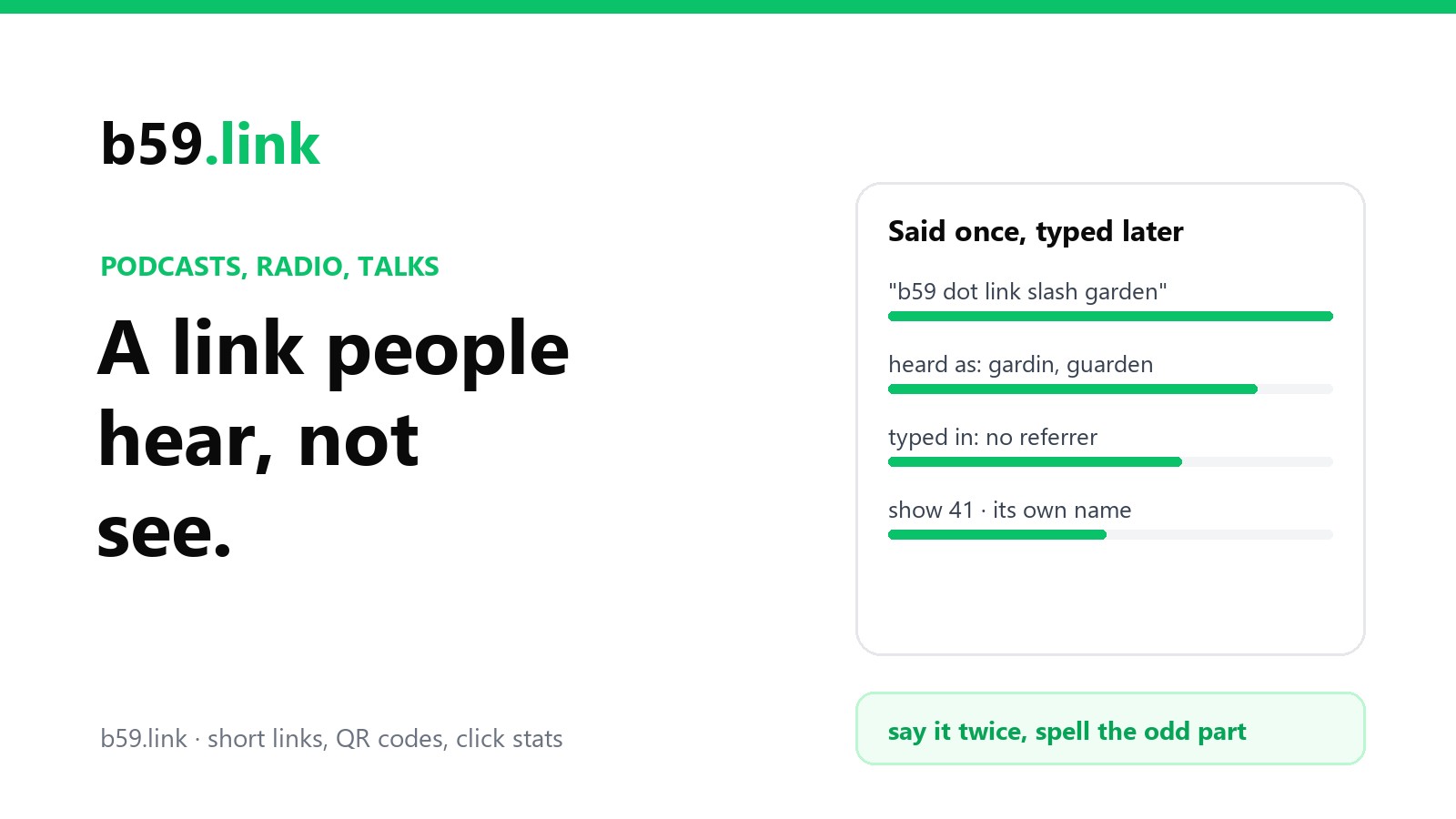
A link in a post gets tapped. A link in a podcast has a much harder trip. The listener hears it once, usually while driving, cooking or running. They have to remember it for minutes or hours, and then type it on a phone, from memory, without ever having seen it written down.
Most spoken links don't survive that trip. This guide is about the ones that do: how to choose the name, how to say it, and how to read the visits that come in afterwards. It applies equally to a podcast ad, a local radio spot, a conference talk, a sermon, a school assembly or a voicemail greeting.
The radio test
Domain sellers have used a check for years called the radio test: say the name once to someone who hasn't seen it, and ask them to write it down. If they spell it right, it passes. If they ask "with a hyphen?" or "the number or the word?", it fails.
A short link has two parts to test: the domain and the name after the slash. You usually can't change the domain, so the name has to do the work. Try it on two people before you record. It takes a minute and saves a season of lost visits.
What breaks a spoken name
Hyphens and underscores. Nobody remembers where the hyphen went, or whether there was one. "b59.link/spring-sale" gets typed as springsale half the time. If a name needs two words, run them together: springsale.
Numbers. "Four" could be 4, four or for. "Two" could be 2, two, to or too. Episode numbers are the classic trap: /ep41 is said as "e-p forty-one" and typed as ep-41, episode41 or e41. Use a word instead if you can (/gardening), or register every likely form (more on that below).
Letters that sound alike. Over a phone line, a car speaker or a cheap earbud, B, D, E, G, P, T, V and Z all sound much the same, and so do M and N, and F and S. Speech engineers call the first group the E-set, because these letters differ only in a short sound before the "ee". A name like /bdp or /tv will be mistyped. A name made of ordinary words won't.
Spellings people can't guess. Brand names spelled differently from the word (/kwik, /lite, /xpress), names of people (/caitlin or /katelyn?), and words spelled differently in British and American English (/colour, /organise). If your show has listeners in both, pick the word that's spelled the same in both.
Capitals. You can't hear them. On b59.link, as on most shorteners, the name is case-sensitive: b59.link/mcp-setup works and b59.link/MCP-SETUP is a 404. Some phone keyboards capitalise the first letter when the address is typed into a notes app or a search box, so a listener can end up with /Gardening without meaning to. Use lowercase names, and if the name is going on air, register the capitalised version too.
Register the mistakes
Once you have a name, write down the three or four ways a listener might get it wrong, and make each one a short link to the same place. For a link said as "b59 dot link slash gardening":
Each spare link costs nothing, and each one shows in your stats as its own line. After a month you'll know which mistakes people really make, and you can stop guessing next time. If /garden gets more visits than /gardening, that's the name your listeners remember, so use it in the next ad.
One honest note about our own service: on b59.link's home page the short name is picked for you. To choose names like gardening you need the API or the MCP tools for AI assistants (see making short links from your AI assistant); a field on the home page is on our list.
How to say it
Say it twice. Once in the middle of the segment and once at the end. The first time, people are still deciding whether to care. By the second, they're ready to remember it.
Say the whole thing, the same way every time. "b59 dot link, slash gardening." Don't change it to "at b59 dot link" or "on our site" next time. People remember the rhythm.
Spell the part that's strange. You don't need to spell gardening. You do need to spell anything that a listener couldn't guess: "that's K-W-I-K". For a domain ending listeners don't hear often, like .link, .io or .co, say it clearly and add "not dot com" if you suspect they'll get it wrong. Many people still type .com automatically.
Tell them what's there. "The planting chart is at b59 dot link slash gardening" is easier to remember than a bare address, because it gives the name a reason to exist.
Write it where you can. Spoken links do better when they're also in the show notes, on the last slide of the talk, or in the station's website listing. Many listeners will look there first. That's fine: use a different short link in the written places, so you can tell the two apart.
Some people will search instead
A lot of listeners won't type an address at all. They'll type "gardening podcast planting chart" or your show's name into Google. You can't count those as link visits, and you can't stop it. What you can do is make sure that when they search, the page you mentioned is easy to find: same title as what you said on air, linked from your show's main page, and in that episode's notes.
A separate name for each show
If you sponsor three podcasts, or run the same radio ad on two stations, give each one its own name: /gardenshow, /greenfm, /plotters. Pick names that are each easy to say on their own, not variants of one another, or listeners will mix them up and your counts will be wrong. Then each show's results land in a separate line. It's the same reason we suggest one short link per flyer, post and podcast.
Put the UTM tags on the destination, not in what you say. The short link can forward to yoursite.com/chart?utm_source=gardenshow&utm_medium=audio&utm_campaign=spring, and nobody has to hear any of it. If you use UTM tags, settle on the names first; our UTM naming sheet has a page you can copy.
What a typed visit looks like in your stats
When someone taps a link in a web page, the browser usually tells the next site where the click came from. That's the referrer. When someone types an address, there's nothing to report, so a typed visit arrives with no referrer at all.
On b59.link's stats page those visits are listed as Direct / None. In Google Analytics they're filed under (direct) / (none). Neither is a fault. For a spoken link, almost every visit should look like that. If you see a referrer, someone found the link written somewhere: show notes, a transcript, a listener's post. That's worth knowing too.
Two other patterns you'll see:
- Visits come late and slowly. A post's clicks arrive in the first day. A podcast's arrive over weeks, as people listen to older episodes. Keep the link working for months after the campaign, and don't judge the result after three days.
- Visits cluster at odd times. Radio and podcasts are heard in the morning drive, the evening commute and at weekends. A burst at 8 a.m. on a Saturday is probably someone who listened on Friday night and remembered.
And one limit to keep in mind: the link count is the floor, not the total. Some listeners will search, some will remember your shop's name and walk in, some will tell a friend. If you need a fuller picture, ask new customers how they heard about you, and add the answers to what the links tell you.
Checklist before recording
- The name is one or two ordinary words run together, in lowercase, with no hyphen, digit or unusual spelling.
- Two people who hadn't seen it wrote it down correctly after hearing it once.
- The likely mistakes and the capitalised form are registered and point to the same place.
- Each show or station has its own name.
- The destination page works on a phone and says what you said it would.
- The script says the link twice and spells only the strange part.
- A different short link goes in the show notes.
Sources: the radio test as described by domain brokers, among them Lean Domain Search's FAQ (hyphens and numbers) and DomainDetails; Fairing, Why most brands undervalue their podcast ads (2025, on listeners who skip codes and links); Google Analytics Help, default channel groups (the (direct) / (none) label). The case-sensitivity test (/mcp-setup 302, /MCP-SETUP 404) was run against b59.link on 15 October 2026.
Make a short link for your next episode or talk, and see when the typed visits come in.
Create a short link