A poster for a choir, a yoga class, a repair café or a quiz night goes up on the library board, the café wall and the church porch. Someone notices it while waiting for a coffee, scans the code, and it opens a sign-up form. That's the easy part. The hard part is everything after: the form fills up, the event happens, the poster stays on the café wall for another month, and people keep scanning a code that opens 'This form is no longer accepting responses'.
This guide covers how big the code and the address need to be on an A4 or A5 poster, what the code should open before, during and after the event, how long noticeboards actually keep posters up, who won't scan at all, and how a different link per board shows you which boards are worth the walk.
How long your poster will be up
Every board has its own rules, and most of them are written down. A sample of real policies:
Two things follow. First, A4 (or US letter) is the size to design for; A5 fits more boards, A3 fits almost none. Second, the rules say 'removed after the event', but boards are cleared when someone gets round to it: weekly, fortnightly, or when the board is full. Plan for the poster to be seen for a week or more after your event, and for some boards to take it down before.
Outdoors in England, community event posters have a legal clock too. Under the advertisement regulations, a sign for a local charitable, religious, educational, social or recreational event can go up without planning consent (with the landowner's permission), at most 0.6 m², no more than 28 days before the event, and must come down within 14 days after it. Posters on benches, bins and lamp posts aren't covered, and councils treat them as fly-posting.
What the code should open, and when
Here's the problem with printing a form's address in the code: the form has one job and one lifetime, and the poster outlives it. A short link you control can open the right thing at each stage, while the printed code stays the same:
Compare what the platforms show if the code opens them directly. An ended Eventbrite page stays up with 'Event ended' and 'Sales ended', and suggests other organisers' events under 'Explore similar events'. A closed Google Form shows 'This form is no longer accepting responses' (you can edit that message, and schedule the form to close on a date or after a number of responses, which is worth doing anyway). Neither tells the person who just scanned your poster when the next one is.
forms.gle links are short, and that's handy, but they're Google's short links: they always open that one form. They can't be moved to next term's form or a 'see you in January' page.
How big the code needs to be
The usual rule for QR codes is a code about a tenth as wide as the distance it's scanned from, for a simple code. Denser codes need more. We encoded four typical links for a club poster at error correction level M and worked out how far away each code width reaches:
People read a noticeboard from about arm's length to a step back, and a crowded board means stepping back to see past other posters. On an A4 poster, a 6-8 cm code with a short link works from where people stand, which still leaves plenty of room. A full form address needs a 10 cm code to reach half a metre, and that's almost half the width of an A4 sheet. Leave a white margin around the code (four squares' width) so the poster's colours don't run into it. Our print size calculator does this sum for any link and distance.
The words matter more than the code
Print the date, time, place and the short address in letters big enough to read from the same distance. The US accessibility standard for signs (ADA, table 703.5.5) asks for capital letters at least 16 mm tall for reading from under 1.83 m. On a poster that's about 65-point type for the date and the address. The short address (b59.link/choir-autumn) is there for people who'd rather type it, or who take a photo of the poster and look later.
Not everyone will scan
A code is the quickest way in for most people, and no way in at all for some. The numbers by age:
For a club whose members are mostly over 60 (a lunch club, a walking group, a bridge class), the code is the extra, not the main way in: put a phone number in large print, and tear-off strips along the bottom with the phone number and the short address. Charities that reach people offline do exactly this: Papyrus UK sells a tear-off poster with the phone number on perforated strips. A row of strips also tells you something a code can't: count the missing ones when you pass.
One link per board
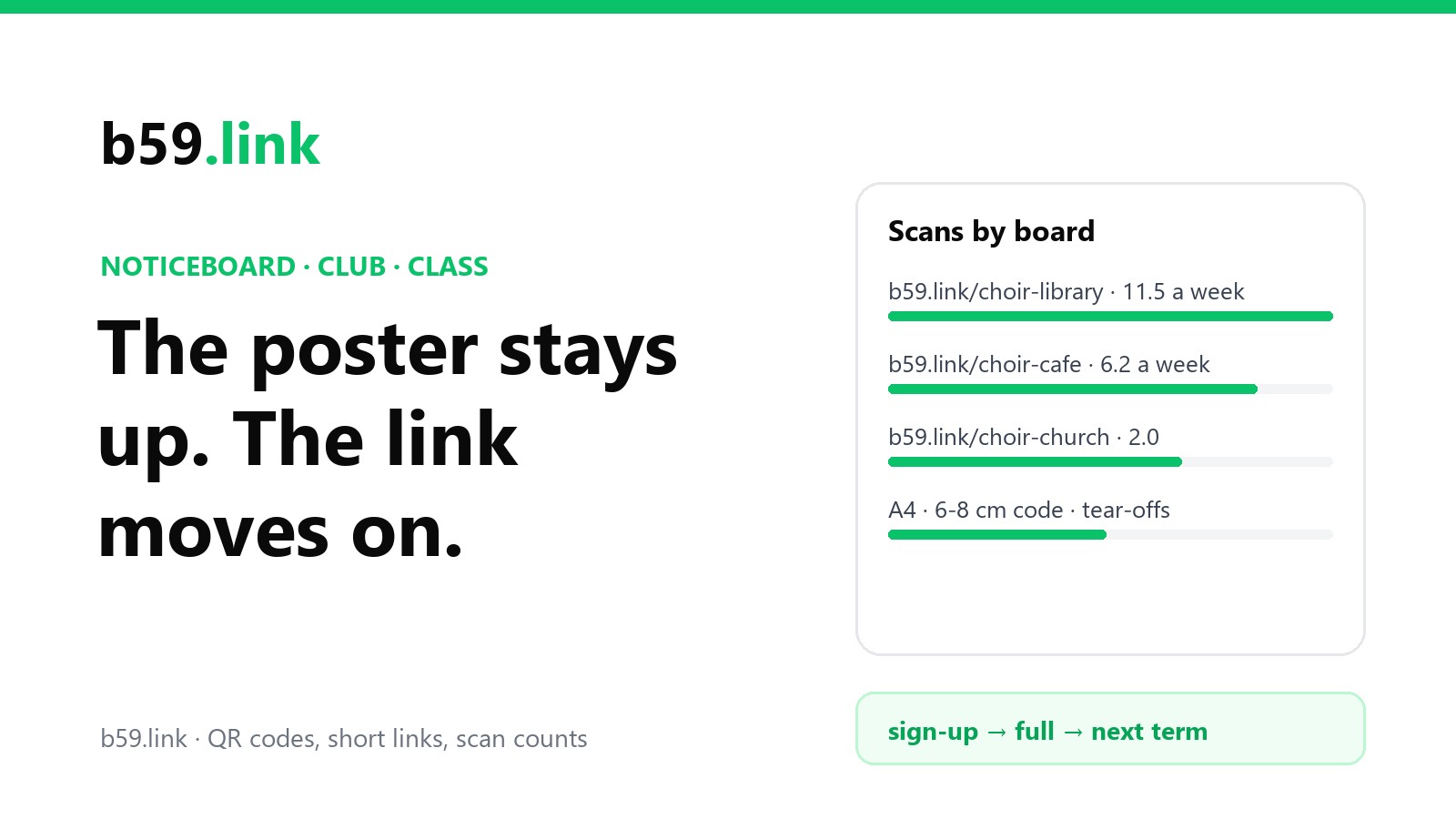
If you put up posters in five places, give each one its own short link, all opening the same page. Then you know which boards are worth the walk next term. A term's worth for a community choir could look like this (made-up numbers to show the reading):
Per week is the fair comparison, because each board kept the poster for a different time. The library was taken down after two weeks but did best while it was up; the café kept it for five weeks and earned its place by the end. The surgery's few scans turned into people who came. The leisure centre poster vanished in nine days. Next term: two copies at the library, a reprint at the café halfway through, skip the gym.
Making five links by hand is fiddly; our campaign link tool makes one per place in one go, with a CSV to keep. The idea is the same as one short link per flyer and post, just on cork board.
Taking it down
Everyone means to collect their posters after the event. Many don't, and the board clears on its own schedule. So the link has to be the thing you look after, and the poster can be forgotten:
1. The day after the event, point the link at a 'thanks for coming, next one is ...' page.
2. Collect the posters you can within a week; outdoors in England, within 14 days is the law for event signs.
3. Keep the link alive for at least a term. Posters turn up in photos, on other boards, in people's bags.
4. Next term, print new posters with new board links (choir-spring-library), so the counts start fresh, and leave the old ones pointing at the current page.
For a class that runs every term, a permanent club link (b59.link/choir) printed on everything, plus one link per board per term for counting, is the tidy version. If the event needs to go in people's calendars, our add-to-calendar link builder makes the links for the event page.
Poster checklist
1. A4 or US letter, or A5 for boards that ask for it.
2. What, when, where, in letters you can read from a step back.
3. A 6-8 cm QR code with a short link, a white margin around it, and the short address printed underneath.
4. A phone number, and tear-off strips if your people are older.
5. One short link per board.
6. Before printing: scan the code from a step away with an older phone.
7. Change where the link points as the event fills up, happens and ends.
Make a short link and QR code for your poster, one per noticeboard, and point it at next term's page when this one's over. Free.
Make a QR codeSources
- Noticeboard policies: Bath & North East Somerset Libraries 'Notices & Poster Policy'; Royal Borough of Kingston 'Neighbourhood Noticeboard Guidance' (updated February 2023); Epsom & Ewell Borough Council community notice boards; Datchet Parish Council Noticeboard Policy V1 (approved 11 May 2026); Croydon Libraries notice and poster display policy; Anchorage Public Library posting policy (20 October 2021); City of Stonnington Library community display policy.
- Department for Communities and Local Government, 'Outdoor advertisements and signs: a guide for advertisers' (June 2007), on the Town and Country Planning (Control of Advertisements) (England) Regulations 2007, Schedule 3 Class 3; Winchester City Council, 'Event advertising on land and roadsides'.
- Eventbrite: an ended public listing (viewed October 2026) and Eventbrite Help Center on unpublishing events; Google Docs Editors Help, 'View & manage form responses' (closing a form, close date, response limit; read October 2026).
- YouGov US, 'Are QR codes leaving older Americans behind?' (28 June 2021, 1,200 adults); YouGov GB, 'Are older Brits being excluded by the QR code renaissance?' (23 September 2021, 1,185 adults); AARP on the William Blair Equity Research survey (March 2023); Ofcom, Adults' Media Use and Attitudes report 2024.
- 2010 ADA Standards for Accessible Design, table 703.5.5 (visual character height); Scanova and QRStuff on the 10:1 scanning distance rule.
- Papyrus UK, tear-off poster.
- Our sums (October 2026): QR versions from the Python qrcode library at level M; reach = the 10:1 rule for a 25 × 25 code, scaled down for denser codes so each square keeps the same size (the same maths as our print size calculator).