A plant label has two jobs. In the garden centre it sells the plant: name, flower colour, height, sun or shade. At home, months later, it's the only thing left that knows what the plant is, and that's when people need it most: the leaves have gone yellow, it's March and nobody remembers whether this rose gets cut back now or in autumn.
A QR code on the label can carry the second job, but only if three things hold: the code is big enough to scan on a stake two centimetres wide, the print survives a season of sun and watering, and the page behind it is still there and still right next spring. This guide covers all three, with our own size and fading tests, and how to count which plants people actually scan.
What the code should open
Not your home page, and not the shop. The person scanning is standing in a border holding a muddy label. They want to know what to do with this plant, now. That gives a short list:
The big plant brands settled on care. Proven Winners' houseplant tags open animated care instructions (light, water, feeding); Monrovia's tag code opens ideas for using the plant, flowering time, planting and care. A Proven Winners manager said in 2012 that the codes were aimed at use after the sale, not at comparing plants in the store. That matches who scans: the owner, at home.
Why the page has to change with the season
A printed tag says the same thing all year. The plant doesn't need the same thing all year. The Royal Horticultural Society's month-by-month advice for trees and shrubs, for an ordinary rose and its neighbours:
So the care page should open with this month's job at the top, and the full year underneath. A short link in the code lets you do more than edit that page: if the nursery moves to a new website, or the care guides move from a blog to the shop, you point the short link at the new address and every label already in someone's garden keeps working. Printing the care page's own address in the code ties thousands of labels to one URL structure for good. Our article on what to encode on packaging makes the same case for product boxes.
How big the code can be on a stake
Plant stakes are narrow. Real sizes from suppliers: 120 × 13 mm and 13 cm × 12 mm stakes, 5/8 × 5 inch (16 mm) styrene stakes in the US, 2 × 10 cm stakes, and 120 × 20 or 120 × 25 mm stick tags made for thermal printers. A QR code is square, so the stake's width is the most it can be, and it also needs a white margin (the quiet zone) four squares wide on every side.
We worked out how big each square gets when the code and its margin fill the width of the stake, leaving 1 mm at each edge. Error correction level M, the usual default:
For a sense of scale: GS1, which sets the rules for barcodes on retail products, asks for squares of at least 0.396 mm on consumer packaging and aims for 0.495 mm. A short link on a 20 mm stake clears that comfortably. The care page's own address only just scrapes the minimum on a 20 mm stake, and with tracking tags added it's at the minimum even on a 25 mm tag. On a 13 mm stake, nothing reaches it.
Three letters make a difference here: r-iceberg gives a 25 × 25 code, rosa-iceberg tips it over to 29 × 29. Keep the names short. To check a particular link and label, our print size calculator does it for any width and reading distance.
How close people have to hold it
Nobody scans a stake from standing height. We simulated phone photos of a short-link code and a care-page code on a 20 mm stake: the code drawn at its real size, shrunk to what a phone's main camera sees at 15, 25 and 35 cm (about 1,445 pixels per metre at 1 m in a 1,920-pixel frame), blurred, with sensor noise and JPEG compression, and decoded with the open-source zxing-cpp library, 10 photos per cell:
So the scan happens with the label in someone's hand, or the phone held right down at the pot. That's fine on a bench, where people pick plants up anyway. It's not fine for a label pushed deep into a pot behind three others, or a code at the back of a raised bed. If people can't get within about 25 cm of it, the code needs to be bigger, and that means a sign, not a stake (see below).
What lasts outdoors
The label material and the way it's printed decide how long the code stays scannable. What manufacturers and testers actually claim:
Those are makers' claims, mostly for their own products, so treat them as the best case. Gardeners report plastic stakes going brittle after 3 or 4 years, and a botanic garden switched to anodised aluminium for that reason; others report black-on-white anodised plaques starting to fade too.
The ink matters as much as the label. Printers rate ink fade on the Blue Wool scale from 1 to 8. One UK label printer's guide puts the average outdoor life of a Blue Wool 4 ink at up to 3 months, 5 at up to 6 months and 6 at over 6 months. Colours fade first; black pigment and resin hold best. Print the code in black, even if the rest of the label is in colour.
Fading alone isn't what kills it
We ran the same simulated photos with the black squares faded towards grey (0 = black, 255 = white), on a clean white label and on one yellowed or dirty enough to drop the background to 200:
A code faded to a pale grey still reads on a clean label: the scanner looks at the difference between dark and light, not at how black the black is. What breaks it is the gap closing from both sides, faded print on a label that has gone cream, green or muddy. Even at 15 cm, the dirty label failed every photo once the squares had faded to 185. So: black resin print on white, a matt face that doesn't hold glare, and a wipe when the stock is watered. Soil splash on the lower half of a stake is normal; keep the code on the top half.
One page per variety or one per range
Per variety is more useful and more work. A middle path most nurseries can manage:
The short link names are worth planning once, as a sheet, before the first print run. Prefixes by group (r- roses, p- perennials, s- shrubs) keep them short and stop two plants fighting over the same name.
Counting which plants get scanned
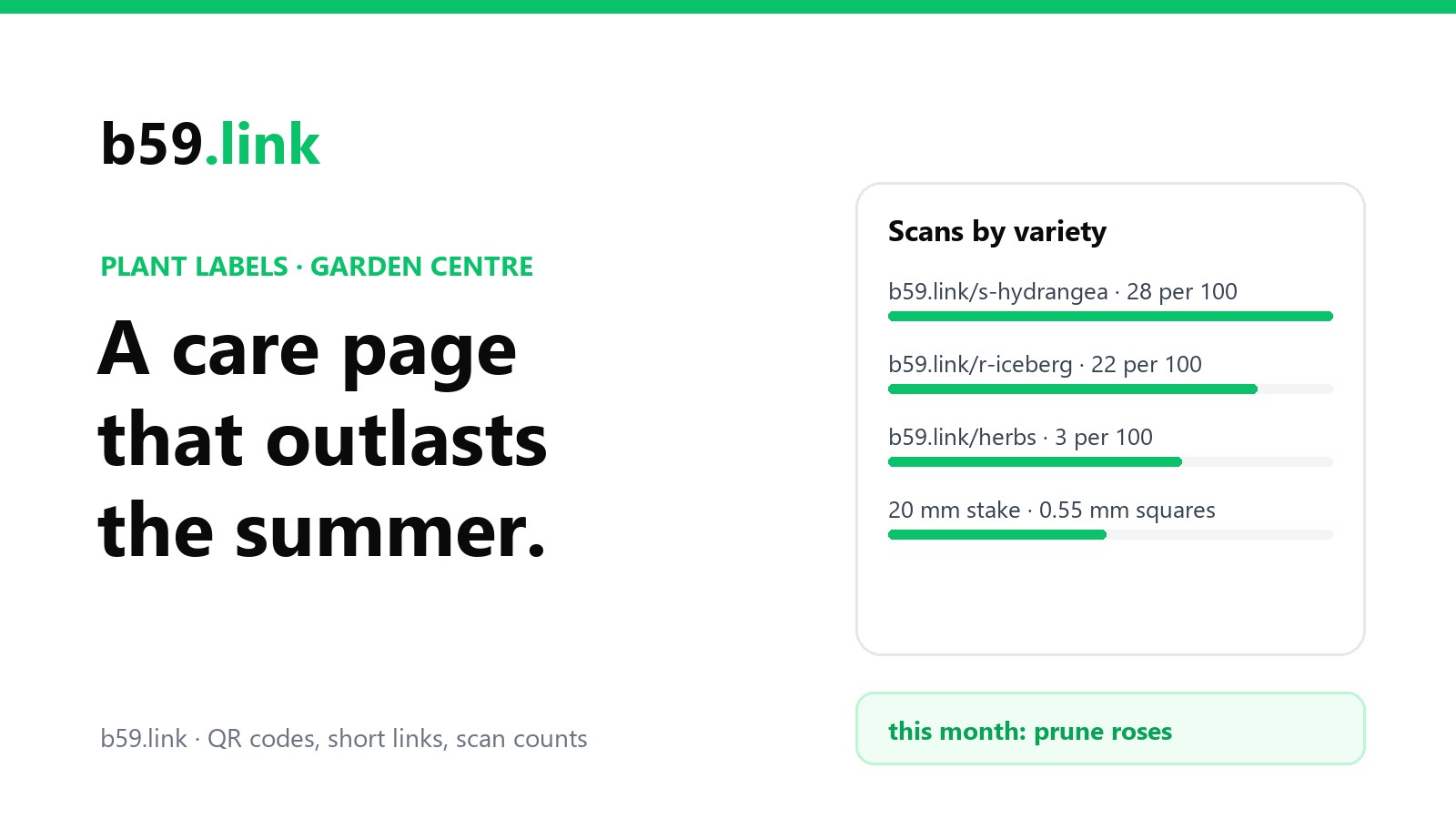
Here's the honest state of the data: nobody publishes plant-tag scan rates. A grower who ran a QR programme with monthly scan reports in 2011 never released the numbers, and a Proven Winners manager said of their codes that it's hard to know if they were actually used. If every variety has its own short link, you don't have to guess. Half a season's scans could look like this (made-up numbers to show the reading):
Read like that, the numbers tell you what to write next. Hydrangeas scanned in high summer: people are asking why the flowers changed colour or why it's wilting, so that's the section to improve. Roses peak in the two pruning months. Herbs are almost never scanned: cheap, short-lived, care is obvious, so a range page is plenty. The bench sign gets its scans at weekends, in the shop: that's a selling sign, not a care label, and should open the plants on the bench with what's in stock.
Count per 100 plants sold, not raw scans, or the best seller always looks like the best label. And scans from inside the garden centre (weekend daytime, the sign links) are a different crowd from scans months later in a garden.
Bench, bed and display signs
Signs are where the code can be big enough to scan from a step away. The usual rule is a code about a tenth of the reading distance: a 10 cm code for someone a metre away, 5 cm at half a metre. A 3 × 5 inch T-sign in a border takes a 5-6 cm code. An A5 sign in a waterproof pocket on a bench end can hold a 10 cm code, readable from the path. Signs also get replaced every season, so they're the place to try a different link and compare.
Checklist before the season's labels go to print
1. Decide the link per group: variety, genus or range. Write the names as a sheet.
2. Make the short links and point them at the care pages (or one holding page per group to start).
3. Put this month's job at the top of each care page.
4. Print the code in black, at least 0.4 mm a square: on a 20 mm stake, that means a short link, not the page address.
5. Print the short address under the code in plain text (b59.link/r-iceberg), for anyone who'd rather type it.
6. Use resin thermal transfer or a laser label rated for outdoors; never direct thermal.
7. Scan a test stake from 25 cm, then leave it out on the bench for a fortnight and scan it again.
8. When the website changes, repoint the links. The labels in people's gardens stay the same.
If you also have signs and bench cards with codes around the site, our code register checks a walk-round of photos against the address each sign should hold, so a reprinted sign with the wrong link doesn't sit there all summer.
Make a short link and QR code for each variety, change where it points when your site changes, and see which plants get scanned. Free.
Make a QR codeSources
- Royal Horticultural Society, month-by-month advice for trees and shrubs (March, April, June, October), read October 2026.
- Greenhouse Grower, 'New Directions in Plant Labeling and Packaging' (13 January 2026: Proven Winners leafjoy care codes, Costa Farms); Wenke Greenhouses QR programme (8 December 2011).
- Greenhouse Management, 'Doing more with the QR code' (January 2012) and interviews with Proven Winners' Karin Walters.
- Monrovia, 'What's in a label?' (2026); Bloomin' Easy, plant tag care reminders.
- GS1 UK, QR codes powered by GS1: design and sizing guidelines (X-dimension 0.396 mm minimum, 0.495 mm target).
- DENSO WAVE, qrcode.com: quiet zone of four modules.
- Honeywell ThermaMAX TMX3000 resin ribbon brochure; TSC Printers on wax, wax-resin and resin ribbons; VanDerEng Duraflex stick tags; Avery 61550 vinyl label (discontinued); PlantFile laminated labels; GPC Labels and Camcode on anodised aluminium; Which?, 'Best plastic-free plant labels'.
- Hibiscus Plc, 'The Blue Wool Scale and the light-fastness of ink' (UK fade times by Blue Wool rating).
- Supplier listings for stake sizes: Dr Green Thumbs (120 × 13 mm), allotment-garden.org (13 cm × 12 mm), Scenic Hill Farm (4 × 5/8 in), Harrod Horticultural (T-labels), Centurion (3 × 5 in T-signs).
- Reports on plastic labels going brittle and anodised plaques fading: Rotary Botanical Gardens; UBC Botanical Garden forum.
- Our tests (October 2026): QR versions from the Python qrcode library at level M; simulated phone photos (1,445 px per metre at 1 m, Gaussian blur, noise, JPEG at quality 75) decoded with zxing-cpp, 10 per cell.