Every small hardware company, workshop brand and boutique electronics maker shares the same quiet dread: discovering a dangerous fault after shipping thousands of units. A batch of faulty thermal fuses in an espresso machine, an overheating lithium cell in an audio interface, or a hairline fracture on a bicycle bracket. Designing the replacement part or issuing a refund is straightforward engineering. The real crisis is finding the people who actually have the product in their homes.
Unless you sell 100% direct-to-consumer and retain active emails for every single order, your customer list is full of holes. Products sell through Amazon, specialty retailers, wholesale distributors, independent gift shops, and third-party dealers. Many are given as gifts. Within two years, a third are passed on or sold second-hand on eBay, Facebook Marketplace, or local classifieds. The packaging and paper instruction leaflets are in the landfill within 48 hours of unboxing.
When regulators demand an urgent recall notice, broadcasting a press release or posting on social media reaches almost nobody. This guide examines the hard data behind product registration, the strict rules under the EU General Product Safety Regulation (GPSR) and US Consumer Product Safety Commission (CPSC), and how placing a permanent, high-density QR code on the physical product rating plate gives makers a direct communication line that outlives the packaging.
The registration and remedy trap: why buyers stay invisible
Consumer product safety agencies have spent decades measuring how many people actually hear about a recall and return a dangerous product. The figures are consistently dismal across every continent.
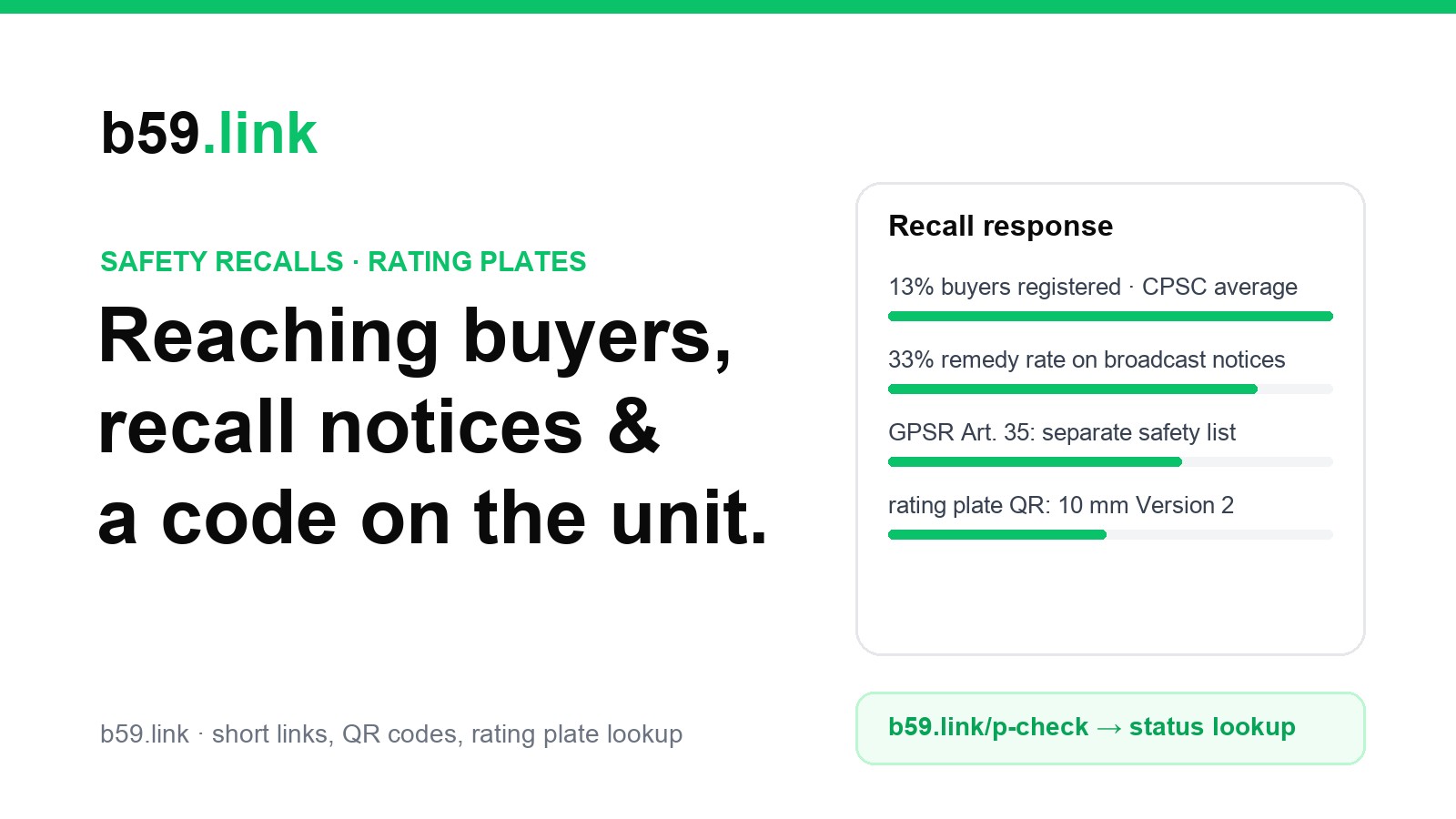
According to research published by the US Consumer Product Safety Commission (CPSC), voluntary consumer product registration averages just 13% across all consumer product categories. For low-cost everyday appliances and electronics, registration rates plummet to between 1% and 4%. Even for durable infant products—where manufacturers are legally mandated under 16 CFR Part 1130 to include postage-paid physical registration cards—registration rates rarely exceed 20% to 45%.
The direct consequence of low registration is low remedy completion. The CPSC's historical recall effectiveness benchmarks show an average remedy rate of only 33% across voluntary recalls. That means two out of every three defective, hazardous products remain in consumers' homes, living rooms, and workshops. For the manufacturer, that unresolved 67% represents an enduring product liability ticking time bomb.
Why do buyers avoid registering? Three plain reasons dominate customer surveys:
• Fear of marketing spam: Buyers know that registering a toaster or audio speaker usually means receiving weekly discount newsletters, promotional spam, and third-party data brokering.
• Friction and time: Filling out a 15-field web form asking for household income, age bracket, and dealer location feels invasive for a $60 hardware purchase.
• Lost connection: Second-hand owners and gift recipients never received the warranty card or order confirmation email in the first place.
Worked numbers: broadcast notice vs. direct registry for 10,000 units
To see what these percentages mean in practice, consider a small electronics maker that ships 10,000 units of a tabletop soldering station or USB power supply. Six months post-launch, an internal capacitor is found to fail under sustained load, presenting a scorch and fire risk. The remedy is a redesigned replacement unit costing $35 per unit shipped.
Here is how the three notification strategies perform across those 10,000 units:
Let us break down why Strategy 3 delivers a nearly 10-fold improvement over standard broadcast outreach:
• Strategy 1 (Broadcast Only): The maker issues an official CPSC/Safety Gate press release, posts a banner on their homepage, and tweets about the recall. Without direct contact details, only about 5% of buyers ever see the alert, and only 420 people bother to claim a remedy. Over 9,500 defective units remain active in customer homes.
• Strategy 2 (Standard Warranty Card): 1,300 buyers filled out the warranty card (13% capture rate). A direct email notification achieves a 70% remedy claim rate (910 units). Combined with 320 broadcast claims from unregistered buyers, 1,230 units are resolved (12.3% remedy rate).
• Strategy 3 (Rating Plate QR Code + Dedicated Safety Registry): A permanent QR code on the unit's rating plate captures 3,800 registrations during initial setup (38%) plus 500 second-hand registrations over 18 months. Direct safety notifications achieve a 78% claim rate (3,354 units). Crucially, another 450 owners scan the rating plate when experiencing anomalous behavior or checking product specs during the recall window, bringing total remedies to 4,154 units (41.5%).
The legal rules: EU GPSR Article 35/36 and US CPSC mandates
Regulators have recognized that voluntary registration systems are broken. Both European and American authorities have introduced strict statutory obligations regarding customer communication during recalls.
EU General Product Safety Regulation (GPSR) — Regulation (EU) 2023/988
In force across all EU Member States, the GPSR establishes binding rules on product traceability and recall execution:
• Article 35 (Separation of Safety Contact Data): If an economic operator offers a product registration system or customer account, it must allow consumers to provide separate contact details solely for safety communications. You are strictly forbidden under EU law and GDPR from using these safety registration details for direct marketing or sales newsletters without unbundled, explicit consent.
• Mandatory Direct Notification: If customer contact details exist, operators must notify affected consumers directly, in writing, without undue delay. Relying solely on a public website announcement when customer data is available is a direct regulatory violation.
• Article 36 (The Written Recall Notice): Under Implementing Regulation (EU) 2024/1435, written notices must carry the bold headline 'Product safety recall'. Makers are strictly prohibited from using softening or downplaying terms such as 'voluntary', 'precautionary', 'discretionary', 'in rare situations', or stating that 'no accidents have been reported'.
• Article 37 (Mandatory Remedies): Consumers must be offered a choice between at least two effective, cost-free remedies from: repair, replacement with an equivalent safe unit, or an adequate financial refund.
• Safety Business Gateway: Manufacturers must submit recall documentation and distribution statistics per Member State to the EU Safety Business Gateway, feeding the EU Safety Gate rapid alert system.
US Consumer Product Safety Commission (CPSC) Requirements
In the United States, Section 15(b) of the Consumer Product Safety Act requires manufacturers, distributors, and retailers to immediately report product defects that create substantial product hazards or unreasonable risks of serious injury. Key requirements include:
• CPSC Fast Track Recalls: Allows manufacturers to initiate an approved corrective action plan within 20 working days, bypassing formal preliminary defect determinations and accelerating remedy distribution.
• Direct Notice Obligations: When a firm has customer records (from direct sales, dealer registrations, or online warranty cards), CPSC guidelines strictly mandate direct email and first-class mail outreach before public press releases are finalized.
• Durable Infant Registrations (16 CFR Part 1130): Requires standardized, postage-paid registration cards and electronic registration forms for infant and toddler nursery products.
Putting the code on the product itself: rating plate sizing and materials
The box is recycled on day one. The paper manual is lost by month three. But the rating plate—the permanent metallic label or laser-etched badge on the underside, rear panel, or battery compartment—remains with the hardware for its entire working life.
Rating plates are compact. Adding a QR code cannot crowd out mandatory electrical ratings, CE/FCC marks, model numbers, and serial codes. Sizing comes down to QR payload length: shorter URLs require fewer squares (modules), resulting in smaller physical codes that phone cameras can scan reliably.
Encoding a clean short link (24 characters, Version 2) requires only 13.2 mm of physical width including margins. A verbose tracking URL with multiple query parameters (78 characters, Version 5) requires 18.0 mm—consuming 86% more surface area on an already crowded metal rating plate. On a 25 mm x 50 mm electronics badge, that 86% area difference is the distinction between a clean layout and an unprintable mess.
For physical durability, paper or basic vinyl stickers will yellow, curl, and tear over a 5-year operating life. Rating plate labels must adhere to the UL 969 marking standard:
• Substrate material: Use matte silver metallized polyester (such as 3M 7871 or 7872) with a top-coat designed for thermal transfer resin ribbon printing, or direct laser-etched anodized aluminum tags.
• Adhesive specification: High-performance acrylic adhesive (e.g. 3M 350 series) rated for operational temperatures from -40°C to +150°C, bonding securely to textured plastics, powder-coated steel, and cast aluminum.
• Chemical and rub resistance: Must withstand standard solvent wiping tests (isopropyl alcohol, hexane, and warm water) without fading the printed QR code squares or compromising readability.
What the code should open: peacetime setup vs. recall alert
A printed QR code on a machine or appliance should never point to an unchangeable hardcoded destination. By using a dynamic short link (or GS1 Digital Link resolver), the maker can alter what the code delivers depending on the lifecycle of the product.
During normal peacetime operation, scanning the rating plate opens a helpful hub that buyers actually want: video setup instructions, replacement parts, and maintenance tips. Right at the top sits an unbundled safety registration field: 'Enter your email for mandatory safety and firmware notices.' Because buyers are not forced to subscribe to marketing newsletters, submission rates are dramatically higher.
If a safety recall occurs three years later, the maker updates the dynamic redirect in seconds. Any owner—whether the original purchaser, a gift recipient, or a second-hand buyer who bought the unit on eBay last week—who scans the rating plate is taken directly to the recall remedy portal.
5 followable steps to make your hardware recall-ready
Setting up a recall-ready product architecture does not require enterprise software or expensive consulting. Any small maker can implement these five steps before their next production run:
1. Reserve a clean, dynamic short link for each model: Assign a dedicated, permanent redirect on your own domain or dynamic shortener (such as b59.link/m-audio1). Keep the URL under 25 characters to ensure a compact Version 2 QR code.
2. Strictly separate safety registrations from marketing: Build a dedicated product safety form that collects only model name, serial/batch number, and email. Label it clearly as an EU GPSR Article 35 safety registry and never pre-check marketing or newsletter boxes.
3. Print the QR code on the permanent rating plate: Place the code directly on the UL 969 certified chassis label or laser-etch it onto the anodized enclosure next to the serial number. Never relegate the code solely to the cardboard box or paper manual.
4. Validate and cleanse email records: Send a clean double opt-in confirmation upon safety registration. Run automated bounce checking so invalid addresses are flagged immediately rather than during a crisis.
5. Pre-draft your GPSR Article 36 notice template: Write your standardized recall notice before shipping unit #1. Include mandatory elements: 'Product safety recall' headline, clear hazard description, photographic identification of the rating plate, and at least two defined Article 37 remedies.
When a safety defect occurs, your speed and reach determine whether a recall is an orderly operational event or a company-ending disaster. Putting a clean, permanent QR code on the product gives your buyers an unbreakable connection back to your team—long after the packaging has disappeared.