A market stall is open for six hours on a Saturday. The customers who liked your marmalade, your sourdough or your hand-thrown mugs are around for the other 162 hours of the week, and most of them will never come back to the same pitch at the same time. A QR code on the stall is how they find you again: the online shop, next week's pre-order, the list of markets you'll be at.
It can also carry information people want at the stall, like ingredients and allergens, but that's where the rules come in. This guide covers what a market customer actually scans, what the allergen rules say about putting information behind a code, how big the code needs to be on a price card, why glossy laminate is the thing that stops it scanning, and how one link per market tells you which pitches are worth the fee.
The numbers behind a market day
Market days are short, busy and modest in takings, which is why the hours after matter:
South Cambridgeshire's guidance for market traders calls a card machine at each stall 'now commonplace'. Payments aren't the gap; staying in touch is. That's what the code is for.
What a market customer scans for
Four things, in roughly this order of how often they matter:
Open Food Network, a not-for-profit platform used by small producers and markets, lists 2,506 food producers and 1,138 shops in the UK: the kind of online shop with order cycles and collection points that a market trader can point a code at. In the US, a 2020 USDA survey found 42% of direct-selling farms' websites could take sales, up from 29% in 2015. Plenty of stallholders already have a shop; the code just has to get people to it.
Allergens: what you can and can't put behind a code
This is the bit to get right, because a QR code doesn't change your legal duties.
UK (England, Wales and Northern Ireland)
- Loose food (cakes on a board, olives from a tub, anything served unwrapped): you must be able to tell customers about the 14 allergens. The legal minimum lets you do it out loud, as long as a sign says the information is available from staff. The Food Standards Agency's best-practice guidance (February 2025), which names market stalls in its audience, goes further: allergen information should be available in writing, ideally without the customer having to ask.
- Paper or digital: the same guidance says businesses 'can decide whether to provide allergen information in paper or digital format', but if it's digital, there should be another way for people who can't use digital formats, and a backup in case the digital information fails. A code alone isn't best practice; a code plus a printed allergen sheet on the stall (or a folder) is.
- Food you wrap before the customer asks (prepacked for direct sale): since 1 October 2021 (Natasha's Law) it needs a label with the name and a full ingredients list with the allergens emphasised. A QR code can't stand in for that label.
- Pre-orders: for food ordered online, written allergen information should be available before ordering and on delivery or collection. Your shop page needs it too.
US
Packaged foods must declare the nine major allergens (milk, eggs, fish, crustacean shellfish, tree nuts, peanuts, wheat, soybeans, and sesame since 1 January 2023), on the label. Loose fresh produce is exempt. For packaged market goods (jams, baked goods, sauces) the allergens go in the ingredients list or a 'Contains:' line, and cottage food labelling rules are set state by state. Nothing we found accepts a QR code in place of the label.
So the useful job for a code on a food stall is the extra detail: full recipes, 'made in a kitchen that also handles nuts', which batches contain what this week. The printed sheet or label carries the legal minimum; the code makes the rest easy to read on a phone in the queue.
How big the code needs to be on a price card
People read a stall from about arm's length to a step back. The usual rule is a code a tenth of the reading distance for a simple code, more for denser ones. We encoded three things a trader might put in the code, at error correction level M:
Price cards come in A6 (105 × 148 mm) and A7 (74 × 105 mm) and smaller. A 6 cm code with a short link fits on an A6 card with room for the price and the name, and reads from where a customer stands at the table. One bigger code (10-14 cm) on a sign at the front of the stall or hanging from the gazebo reaches people browsing from the aisle. A product page address needs a code twice the area for the same distance and makes a busy card. Our print size calculator works it out for any link and distance.
Glossy laminate is the real enemy
Outdoors, cards get laminated, and laminate shines. Under an open sky or a gazebo's strip light, the reflection of the sky lands on part of the code and turns it white in the camera. We tested how much of a code a bright patch can cover before phones give up: a 5 cm code photographed from 60 cm, with a white highlight (plus a soft edge as wide again) placed at random, blur, noise and JPEG compression, decoded with the open-source zxing-cpp library, 20 photos per cell:
A highlight over a tenth of the code stops a level M code every time. Raising error correction to H buys a little, but a glare patch also blurs the squares around it and can sit on one of the three big corner squares the scanner looks for first. The fix isn't in the code, it's in the card:
- Matt laminating pouches, or a matt synthetic paper (polypropylene papers such as Yupo are waterproof without laminate).
- Thicker pouches for outdoors: laminating pouch sizes are per side, so a 125-micron pouch seals to 250 microns; Fellowes lists 175 and 250 micron pouches for outdoor signs. Check your laminator takes them.
- Tilt the card back slightly in its holder so it reflects the ground, not the sky.
- Print the short address under the code so a customer can type it when the sun wins.
Signal at the stall
A code needs the shopper's phone to get online. In the UK, Ofcom's 2025 figures put outdoor 4G from all four networks at 94% of rural premises, so a field market is usually fine, but indoor coverage in rural areas is only 78-84%, which matters for a village hall craft fair or a barn. Busy events add their own trouble: the Dutch Payments Association warns of 'local and temporary overloading of mobile networks' at crowded events. Two consequences: keep prices and allergen sheets on paper, and make the code's main job something that can wait until people are home, such as the shop and the pre-order.
One link per market
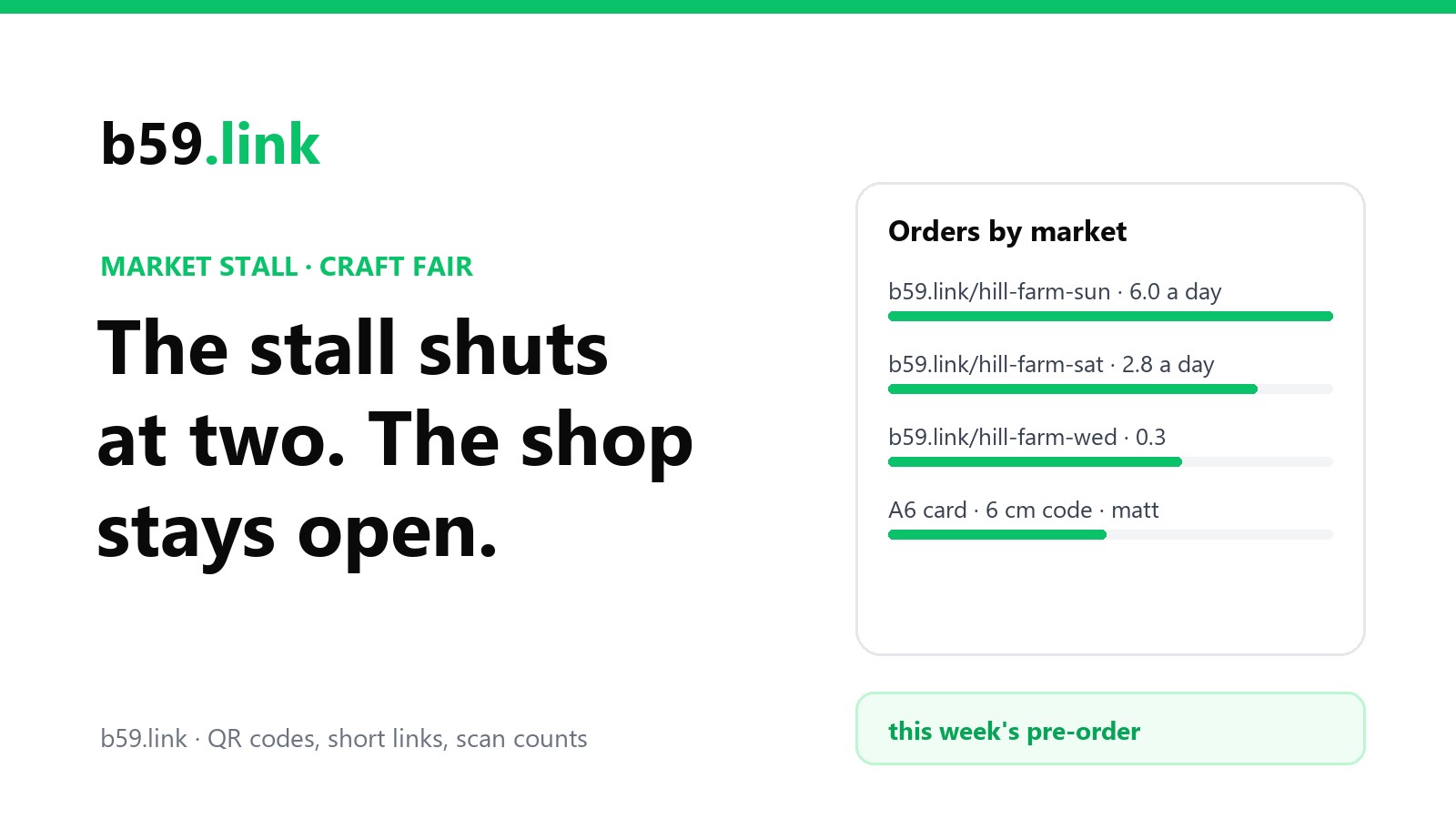
If you stand at several markets, give each its own short link on that market's cards, all opening the same shop. Then you can see which pitches bring customers who come back online. A month for a preserves maker could look like this (made-up numbers to show the reading):
The Sunday farmers' market looks small on scans but its customers order; the midweek market barely earns its pitch fee in follow-up sales. The craft fair is a one-off spike. With one link per market, those decisions come from your own numbers rather than a feeling at the end of a long day. The same idea works for any printed thing: one short link per flyer and post.
Stock that changes every week, behind one printed code
This is where a short link earns its keep. The cards are printed once a season; what's behind them changes:
- This week's pre-order for next Saturday: point the link at the new order form each Monday.
- Sold out of the seasonal line (Seville marmalade in February, mince pies in December): point it at what's in stock now instead of a sold-out product page.
- Moved to a new shop platform: point it at the new shop; the laminated cards on the table don't change.
- Off for the winter: point it at 'back in April, here's the mailing list'.
Printing the shop's own product address in the code fixes the card to one page on one platform for as long as the card lasts. Our guide to QR codes on restaurant tables covers the same problem with menus that change.
Stall checklist
1. One short link per market, pointing at your shop or this week's pre-order.
2. A 6 cm code on A6 price cards, one 10-14 cm code on a sign at the front of the stall.
3. Matt laminate or synthetic paper; tilt the cards back.
4. The short address in print under every code.
5. Allergens on paper as well (UK: a written sheet or the 'ask staff' sign; prepacked food: the full label). The code adds detail, it doesn't replace them.
6. Before the first market: scan the cards outdoors, in sun, from a step back, with an older phone.
7. Every week: repoint the link to what's actually for sale.
Make a short link and QR code for each market, point it at this week's shop or pre-order, and see which pitches bring customers back. Free.
Make a QR codeSources
- Food Standards Agency, 'Allergen information for non-prepacked foods: best practice' (24 February 2025), and its prepacked for direct sale (PPDS) guidance for mobile sellers and street food vendors (Natasha's Law, from 1 October 2021).
- US Food and Drug Administration, 'FASTER Act: sesame is the ninth major food allergen' (sesame labelling from 1 January 2023); FARE, 'Understanding food labels'; NC State Extension farmers market labelling flyer (July 2024).
- USDA Agricultural Marketing Service, National Count of Farmers Market Directory Listings (August 2019); USDA National Farmers Market Manager Survey 2019 (general characteristics and market performance); USDA NASS 2020 Local Food Marketing Practices Survey.
- NABMA Retail Markets Survey 2021/22 (via the London Markets Board); council market fee tables: Ross-on-Wye (2023), North Yorkshire (2024/25), Lichfield (2025-26), Manchester, Camden.
- UK Finance, UK Payment Markets Report 2026 summary (August 2026); Federal Reserve, 2025 Diary of Consumer Payment Choice.
- Etsy Global Seller Census (April 2019); Open Food Network UK (figures on its home page, October 2026).
- South Cambridgeshire District Council, 'Taking payments at markets'.
- Fellowes, 'Choosing the right laminating pouch'.
- Ofcom, Connected Nations UK report 2025 (July 2025 data); Dutch Payments Association on mobile network overload at events (October 2025).
- Our tests (October 2026): QR versions from the Python qrcode library at level M; sizes by the 10:1 rule scaled for denser codes; glare test with simulated phone photos (1,445 px per metre at 1 m, 60 cm away, Gaussian blur, noise, JPEG at quality 80) decoded with zxing-cpp, 20 per cell.