A for-sale or to-let sign has always done one job: tell passers-by who to call. A QR code on it can do more. Someone walking the dog past the house at 9 in the evening can see the photos, the price and the viewing times on the spot, without phoning anyone. But the code has to open the right thing, be big enough to scan from where people actually stand, and still make sense after the place has sold.
This guide is for estate agents, letting agents, landlords and private sellers. Most of it applies equally to a sign for a shop unit, a parking space or a car with a note in the window.
Who scans a sign
Not drivers. Nobody should be scanning a code from behind the wheel, and from a moving car at 10 metres no phone could read a code of a sensible size anyway. The people who scan are on foot: neighbours, dog walkers, people who saw the listing online and came to look at the street, and passengers in a parked car.
That audience is real but small. In the US National Association of Realtors' buyer surveys of the early 2010s, around half of buyers said they used yard signs while searching, but fewer than one in ten found the home they bought through one. A sign code won't sell the house by itself. What it can do is turn a curious passer-by into a viewing, and tell you how many curious passers-by there were.
What the code should open
There are three usual choices, and only one of them survives the sale.
The listing on a property portal. It has the photos and is already done. But you don't control what that page becomes. After the sale or the let, portal pages typically show the home as sold or off the market, next to other agents' listings and adverts. Your sign, still standing, is now sending people to your competitors.
The listing on your own website. Better, because it's yours. But many agency websites delete or hide a listing when it completes, and the code then opens a "page not found". The sign may be gone by then; the flyers and window cards with the same code are not.
A short link you control, pointing at the listing. The code holds b59.link/oak12, for example, and that forwards to the listing today. When the property goes under offer, you change where it points, not the sign: to a page saying "Under offer, viewings still open for a backup buyer", then to "Sold. Here are similar homes nearby" or "Let. Join the waiting list for the next flat in this building". Same sign, same printed code, and every scan still lands somewhere useful. Our guide to retiring a page without breaking the links that point to it goes through where to send people afterwards and why a redirect beats a dead end.
For a private seller or a small landlord without a website, the destination can be a single page: five photos, the price or rent, the number of rooms, viewing times, and a phone number that opens the dialler when tapped. People will be standing in the street on mobile data, so keep it light: no 20 MB photo gallery, no video that plays on its own.
Size: read from the pavement, not the road
The rule printers use is that a QR code should be at least a tenth as wide as the distance it's scanned from (our guide to printing QR codes explains it). A code read from the pavement in front of a front garden, 3 metres away, needs to be about 30 cm wide. From the gate, 1.5 metres away, 15 cm will do.
A typical sign rider, the small strip added under the main board, is around 15 by 60 cm, so a code on it can be about 13 cm: fine for someone who walks up to the gate, too small for someone on the other side of the street. Two practical answers:
- Put the code where people can get close: a rider at eye level near the path, or a small second sign by the gate, rather than high up on the post.
- Print the short address in big letters next to the code: b59.link/oak12. A passenger in a parked car can read and type that more easily than they can scan a code 6 metres away. Choose a name that's easy to read aloud too; our piece on links people hear rather than see has the rules.
Keep the link short, so the code has fewer, larger squares and scans from further away at the same width.
Built for weather
A sign lives outside for weeks or months, which is hard on a QR code.
- Sun fades colour. A code printed in a brand colour slowly turns paler, and pale codes stop scanning in poor light; our test of coloured QR codes shows how quickly. Black on white fades least and starts with the most contrast.
- Gloss reflects. A glossy laminate catches the sun or a street light right across the code at some angles. Matt finishes are kinder.
- Fluted plastic board (the common corrugated sign material) has ridges under the print. Keep the code large and avoid placing it across a fold or an edge.
- Dirt and rain cover parts of the code. Error correction rebuilds some of it, but higher levels also make the code denser. A short link at level M or Q is a good balance outdoors.
- Check it after a storm. Walk past, scan it with your own phone, and replace the rider if it's scuffed.
One link per sign: counting interest
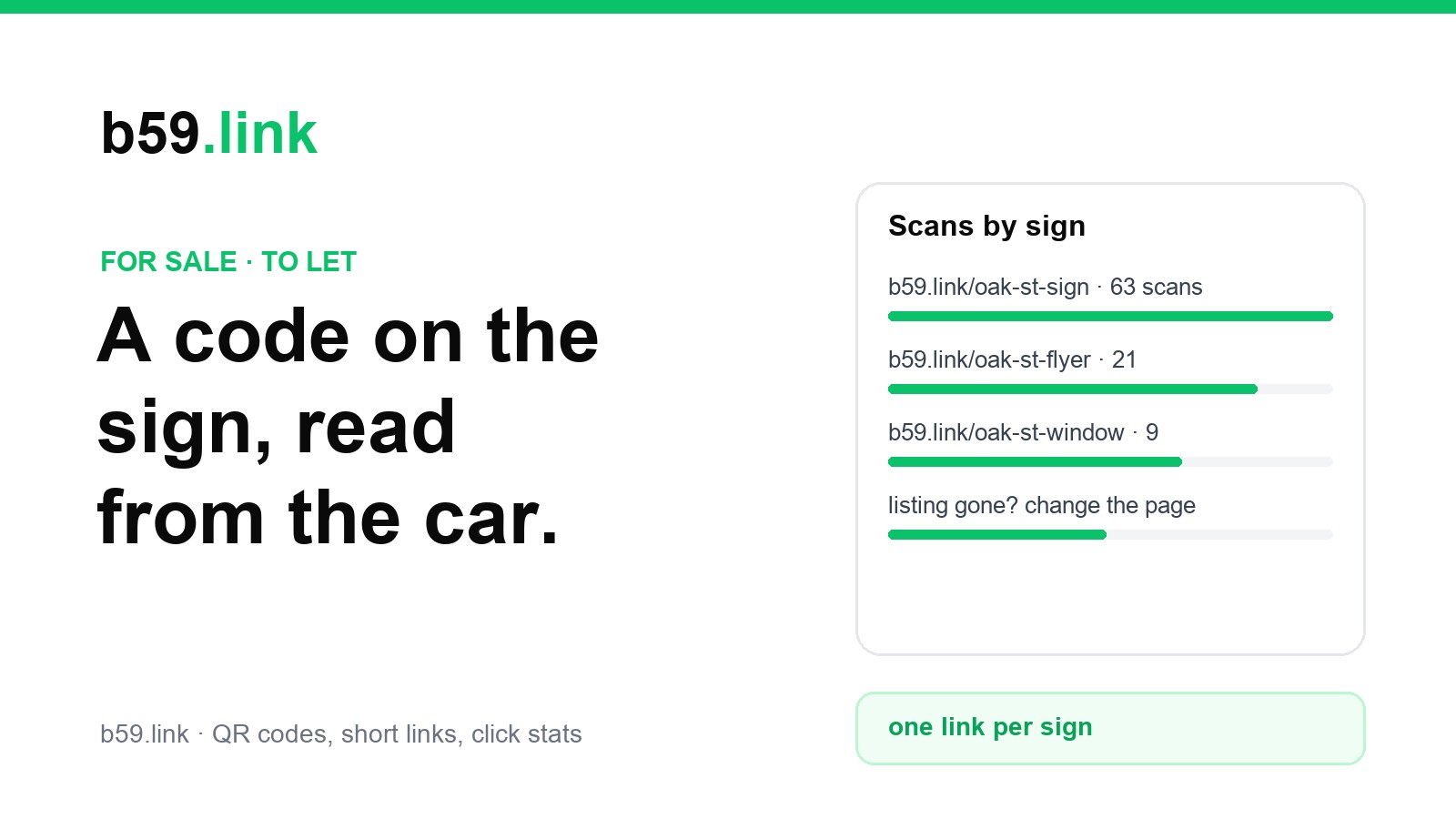
This is where a sign code pays for itself. Give every place the property is advertised its own short link, all pointing at the same page:
Each one is counted separately, so after a week you know whether the board in front of the house brings in more interest than the window card, on which days people scan, and whether the leaflet drop did anything. Compare the scans with the viewing requests from the same week: 60 scans and no calls says the page isn't convincing people, not that nobody saw the sign. One short link per flyer, post and podcast explains the idea in more detail.
For an agent with many properties, the numbers add up to something useful: which streets and which kinds of homes get scanned, and whether the code is worth the space on the next batch of boards.
Expect a few scans that aren't people. Scanner apps, link preview bots and the occasional security check can open a link too; a handful of visits in the minutes after you first test it yourself is usually you.
When the place is gone
Change the destination the day the status changes, not when the sign comes down. The sign often stays up for days afterwards, and the leaflets for much longer.
In England, a "sold" or "let by" board has to come down within 14 days of completion or the start of the tenancy, under the advertisement regulations, and a residential board can be no larger than half a square metre, one per property. Local councils enforce it, some more keenly than others. Other countries and many US towns and homeowners' associations have their own rules on sign size and timing; check before you order boards.
What the short link should point to afterwards depends on who you are. An agent wants the scanner to see similar homes or a valuation offer: someone who stopped to look at a house on this street may well own one nearby. A landlord wants a waiting list for the next vacancy. A private seller who has finished can point it at a simple "Sold, thank you" page, or let it go after a month.
Before the sign goes up
- The code holds a short link you can redirect, not the portal's address.
- The page it opens loads quickly on a phone and shows photos, price, rooms, viewing times and a tap-to-call number.
- The code is at least 13 to 15 cm wide where people can walk up to it, with the short address printed in large letters beside it.
- Black on white, matt finish.
- Each sign, window card and leaflet has its own short link.
- You know what the link will point to when the property is under offer, sold or let.
Sources: National Association of Realtors, Profile of Home Buyers and Sellers, as reported by PropertyID (2012) and Liz Moore & Associates (2015) (yard signs as a search source and as where buyers found their home); Reading Borough Council and Basingstoke and Deane Borough Council on estate agents' boards under the Town and Country Planning (Control of Advertisements) (England) Regulations 2007 (14 days, 0.5 square metres, one board); our own guides to print size and colour contrast, linked above.
Make a short link and QR code for each sign, and see which one people scan.
Create a short link